




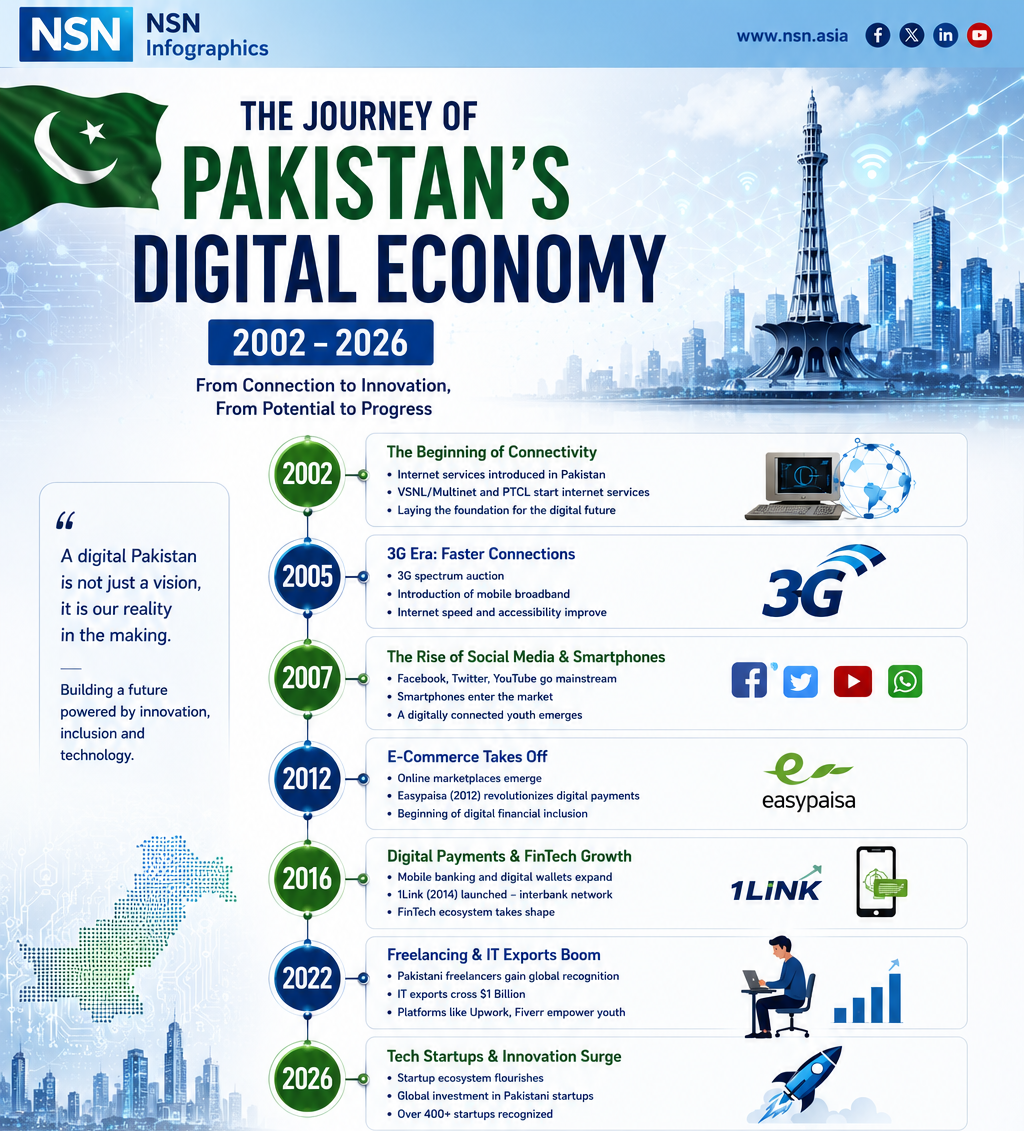
Pakistan's Digital Economy, A 20-Year Journey from Dial Up to Digital Powerhouse NSN Asia 2026 A1
This article traces the journey of Pakistan’s digital economy from 2002 to 2026
Two decades ago, getting online in Pakistan meant a screeching dial-up modem, a handful of internet cafés, and a mobile phone that only the privileged few could afford. Today, the country is home to over 100 million mobile broadband users, a fintech ecosystem processing billions of rupees in instant payments, and one of the world’s fastest-growing freelance workforces.
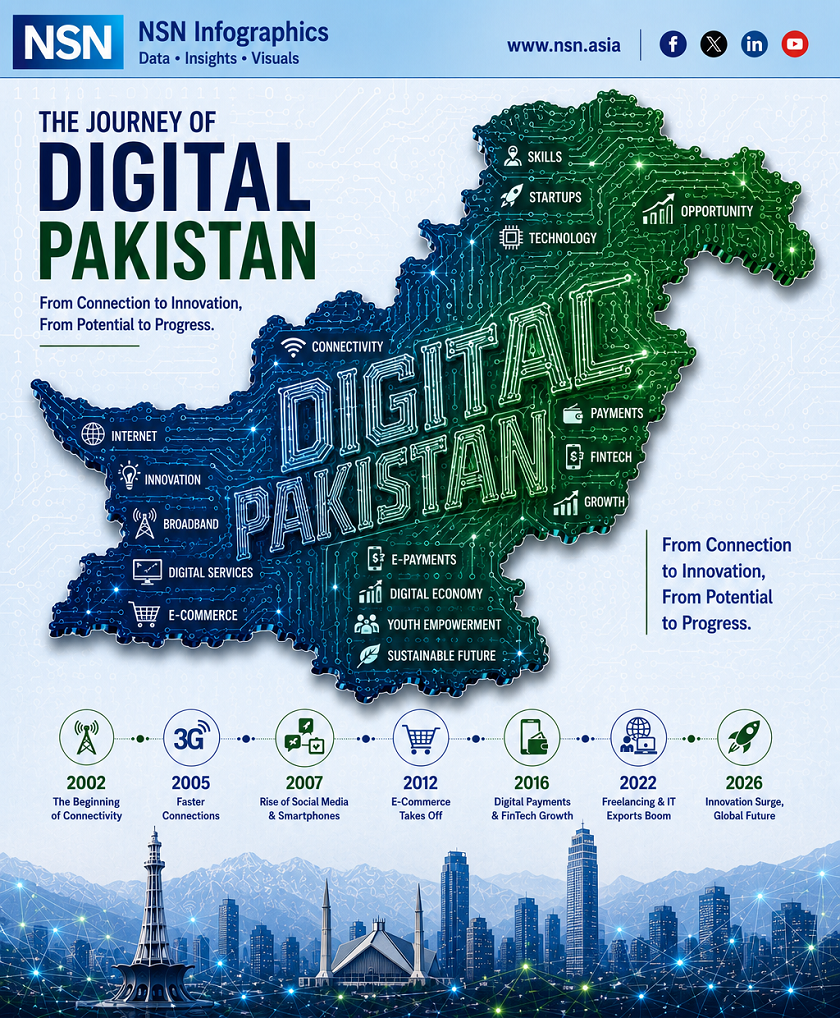
The transformation didn’t happen overnight. It was built policy by policy, auction by auction, and startup by startup — starting with a bold telecom deregulation move in 2002 that set the stage for everything that followed. This article traces the journey of Pakistan’s digital economy from 2002 to 2026, examining the milestones, the numbers, and what lies ahead for one of South Asia’s most dynamic tech markets.
Why Pakistan’s Digital Economy Story Matters
Pakistan is the world’s fifth most populous country, with a median age under 21. That demographic weight, combined with rapidly falling smartphone and data costs, has turned the country into a genuine testing ground for digital-first growth. Understanding how Pakistan got here — and where the gaps remain — offers lessons for other emerging markets navigating the same path from connectivity to a full-fledged digital economy.
2002–2007: The Telecom Deregulation That Started It All
Pakistan’s digital story begins not with an app or a startup, but with a policy decision. In 2002 and 2003, the government deregulated the telecom sector, ending PTCL’s monopoly and opening the mobile market to competition. Companies like Mobilink and Ufone expanded aggressively, and for the first time, owning a mobile phone became realistic for middle-class households rather than a luxury reserved for the elite.
The Pakistan Telecommunication Authority (PTA), empowered during this period, became the regulatory backbone for what would become a rapidly expanding sector. Between 2002 and 2007, mobile teledensity rocketed from roughly 2% to nearly 50% of the population — one of the fastest telecom growth curves in the region at the time.
Internet access during this era was still limited mostly to dial-up and early DSL connections, concentrated in urban centers. But the groundwork — regulatory reform, foreign investment in telecom infrastructure, and a rapidly growing mobile user base — had been laid.
2008–2013: Mobile Broadband and the First Wave of E-Commerce
The next five years were about deepening connectivity. Broadband subscriptions crossed the one-million mark, and internet cafés slowly gave way to home and office connections. Discussions around a 3G/4G spectrum auction began as early as 2008, though political and regulatory delays pushed the actual rollout years down the road.
This period also saw the seeds of Pakistan’s e-commerce sector. Daraz.pk launched in 2012, introducing organized online retail to a market that had largely relied on informal classifieds and word-of-mouth commerce. Meanwhile, banks began experimenting with early digital and branchless banking products, setting up the infrastructure that mobile wallets would later scale dramatically.
2014–2017: The 3G/4G Revolution
If there’s a single inflection point in Pakistan’s digital economy timeline, it’s 2014. That year, the government held its long-awaited 3G/4G spectrum auction, and mobile broadband went live nationwide almost immediately afterward. The effect was immediate and dramatic — smartphone adoption surged as data became affordable and accessible outside major cities for the first time.
This period supercharged two sectors in particular:
- Mobile financial services: Easypaisa and JazzCash scaled rapidly, giving millions of previously unbanked Pakistanis access to digital payments, mobile top-ups, and bill payments through branchless banking agents.
- Freelancing: With reliable mobile internet reaching smaller cities and towns, Pakistani freelancers began tapping into global platforms for software development, design, writing, and virtual assistance work — a trend that would make Pakistan one of the top freelance-exporting countries within a decade.
2018–2020: The Digital Pakistan Policy Era
By 2018, it was clear that ad hoc growth needed a coordinated national strategy. The government launched the “Digital Pakistan” vision, followed by the National Digital Pakistan Policy later that year. The policy framework focused on five pillars: access and connectivity, digital infrastructure, e-government, digital skilling, and innovation and entrepreneurship.
Around the same time, organizations like Ignite (formerly the National ICT R&D Fund) and the Pakistan Software Export Board (PSEB) ramped up support for startups and IT exporters. Fintech licensing reforms from the State Bank of Pakistan (SBP) opened the door for Electronic Money Institutions (EMIs), paving the way for digital-first financial products beyond traditional banking.
By 2019, independent research — including data cited by Payoneer and the Oxford Internet Institute — ranked Pakistan among the top four countries globally for freelance revenue growth, a remarkable outcome for a market that barely had reliable mobile broadband five years earlier.
2020–2022: The Pandemic-Driven Digital Leap
COVID-19 did to Pakistan’s digital economy what years of policy alone could not: it forced rapid, mass adoption. E-commerce platforms saw order volumes spike as lockdowns pushed consumers online. EdTech platforms scaled to keep students learning remotely. Telemedicine, previously a niche offering, became a mainstream necessity almost overnight.
The most consequential infrastructure milestone of this period came in January 2021, when the State Bank of Pakistan launched Raast, the country’s first instant payment system. Raast allowed real-time, low-cost transfers between banks and digital wallets — a foundational piece of infrastructure that fintech companies, e-commerce platforms, and government disbursement programs continue to build on today.
Investor confidence followed the momentum. 2021 became a record-breaking year for Pakistani startups, with venture capital funding crossing roughly $350 million — an unprecedented figure for the local ecosystem, driven by fintech, e-commerce, and logistics startups attracting both regional and global investors.
2022–2024: Fintech Maturity Amid a Global Funding Winter
The global startup funding slowdown that hit markets worldwide in 2022 didn’t spare Pakistan. Venture capital investment cooled significantly compared to the 2021 peak, and several high-profile startups scaled back operations or shut down entirely amid currency devaluation, inflation, and tighter global capital.
But the slowdown in funding didn’t mean a slowdown in usage. Fintech adoption continued to mature, with digital wallets, QR-code payments, and buy-now-pay-later products gaining ground in urban and semi-urban markets. B2B e-commerce — connecting retailers and wholesalers digitally — emerged as a resilient niche even as consumer-facing e-commerce cooled.
On the policy side, the Digital Nation Pakistan Act was passed in 2023, aiming to create a unified digital ID and service delivery framework linked to NADRA’s existing infrastructure. Despite macroeconomic headwinds, IT and IT-enabled services (ITeS) exports continued climbing, underscoring the sector’s relative resilience compared to other parts of the economy.
2024–2026 and Beyond: Scaling and Global Integration
Looking at the current phase, Pakistan’s digital economy is shifting focus from raw connectivity growth toward deeper integration and global competitiveness. Key themes shaping this period include:
- 5G groundwork: Trials and spectrum planning discussions are underway, though full commercial rollout timelines continue to be debated against infrastructure and investment constraints.
- AI policy development: A national AI policy framework has been drafted, aiming to position Pakistan for AI-driven services and workforce development.
- IT export ambitions: Industry bodies and government targets point toward significantly higher IT and ITeS export revenue, building on the sector’s status as one of Pakistan’s more reliable sources of foreign exchange.
- Digital and financial inclusion: Continued expansion of Raast, mobile wallet adoption, and government-to-person digital disbursements aim to bring more of the unbanked population into the formal digital economy.
- Regional connectivity: Pakistan is positioning itself as a digital and outsourcing bridge between South Asia, the Gulf, and Central Asia, leveraging its freelance talent pool and growing tech services sector.
The Numbers That Define the Journey
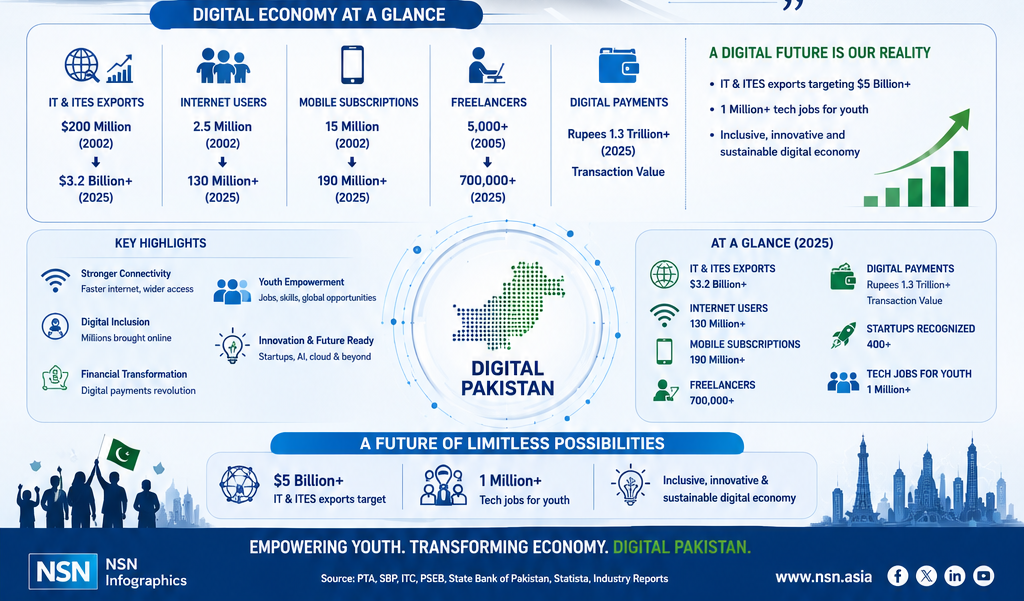
A few statistics capture just how far Pakistan’s digital economy has traveled since 2002:
- Mobile teledensity rose from roughly 2% in 2002 to near-universal penetration today.
- Mobile broadband subscribers now number in the tens of millions, following the 2014 3G/4G rollout.
- Pakistan consistently ranks among the top freelance-earning countries globally, according to multiple industry reports.
- Raast, launched in 2021, has become a core piece of national payments infrastructure.
- Startup funding peaked at roughly $350 million in 2021, before cooling amid the global venture capital slowdown.
Challenges That Still Need Solving
No growth story is without friction, and Pakistan’s digital economy faces real structural challenges:
- The digital gender gap remains significant, with women’s mobile and internet access still trailing men’s in many regions.
- Currency volatility and inflation have made it harder for startups to raise and deploy capital efficiently.
- Cybersecurity and data protection frameworks are still catching up to the pace of digital adoption.
- Rural connectivity gaps persist, meaning the benefits of the digital economy remain unevenly distributed between urban centers and smaller towns.
- Policy consistency across changing governments has occasionally slowed the implementation of otherwise well-designed digital strategies.
What This Means for Businesses and Investors
For businesses, Pakistan’s digital economy represents a market that has moved past the early-adopter phase into genuine mass-market digital behavior — particularly in payments, e-commerce, and remote services. For investors, the story is one of a large, young, increasingly connected population with proven demand for digital financial services, even as near-term capital markets remain cautious.
Freelancers and IT service providers, meanwhile, have arguably been the most consistent beneficiaries of this two-decade transformation, turning Pakistan into a genuine export hub for digital labor even during periods of broader economic uncertainty.
Conclusion: From Connectivity to a Digital Economy
Pakistan’s digital economy didn’t emerge from a single breakthrough — it was built in stages: deregulation opened the door in 2002, mobile broadband widened it in 2014, policy frameworks structured it from 2018 onward, and the pandemic forced mass adoption between 2020 and 2022. Each phase built on the last, and each came with its own set of winners, setbacks, and lessons.
As Pakistan moves through 2026 and beyond, the focus is shifting from simply getting people online to building the deeper infrastructure — 5G, AI policy, digital ID systems, and export-oriented IT growth — that will determine whether the country’s digital economy can scale from a regional success story into a genuinely global one.
About the Author




2 thoughts on “Pakistan’s Digital Economy: A 20-Year Journey from Dial-Up to Digital Powerhouse”
Comments are closed.