




Etihad Rail, Building a New Silk Road Through the Middle Corridor NSN Asia 2026 E
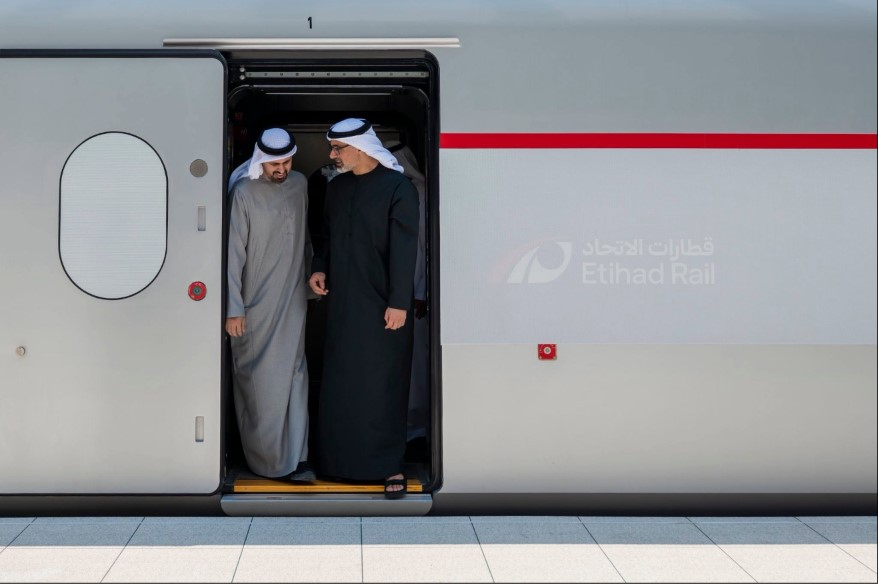
Etihad Rail is positioning the UAE at the heart of a new Eurasian trade order, linking the Gulf to the Middle Corridor and reshaping West Asia’s connectivity map.
**Abu Dhabi —** Long before the first freight wagon rolled across the desert floor of Al Dhafra, Etihad Rail was conceived as something bigger than a domestic transit project. It was designed as a statement of intent: that the United Arab Emirates would not merely sit at the crossroads of global trade, but actively build the tracks that define them. Nearly a decade and a half after its 2009 founding, that ambition is materializing into steel, concrete, and diplomacy — a nearly 900-kilometre national railway now feeding into a much larger vision of Eurasian connectivity, one that planners and diplomats increasingly describe as a 21st-century Silk Road running through the Gulf.
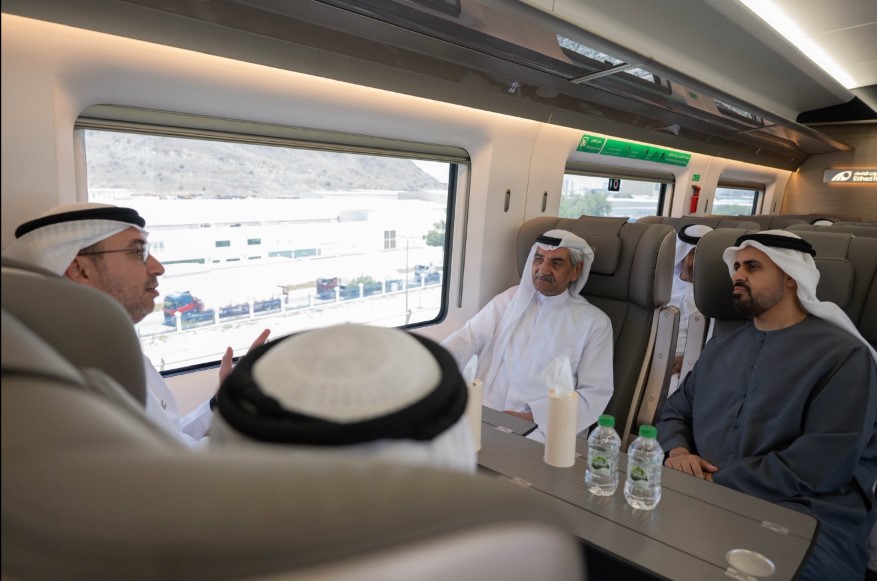
With freight operations fully live across all seven emirates and passenger services beginning their phased rollout in 2026, Etihad Rail has moved from blueprint to backbone. But its significance extends well past the UAE’s borders. As geopolitical shocks — from Red Sea shipping disruptions to conflict-driven detours around the Suez Canal — expose the fragility of existing global trade arteries, Gulf rail infrastructure is emerging as a serious contender in the search for resilient, diversified overland routes between Asia and Europe. Etihad Rail sits squarely at the center of that recalibration.
## From National Network to Regional Backbone
Etihad Rail’s core mission was always dual-purpose: unify the UAE’s seven emirates under a single rail spine, and serve as the UAE’s segment of the long-discussed Gulf Cooperation Council (GCC) Railway. The GCC railway network connects the UAE with Saudi Arabia, Qatar, Kuwait, Bahrain, and Oman, offering a sustainable and efficient alternative for the transportation of freight and capable of handling around 50 million tonnes of freight.
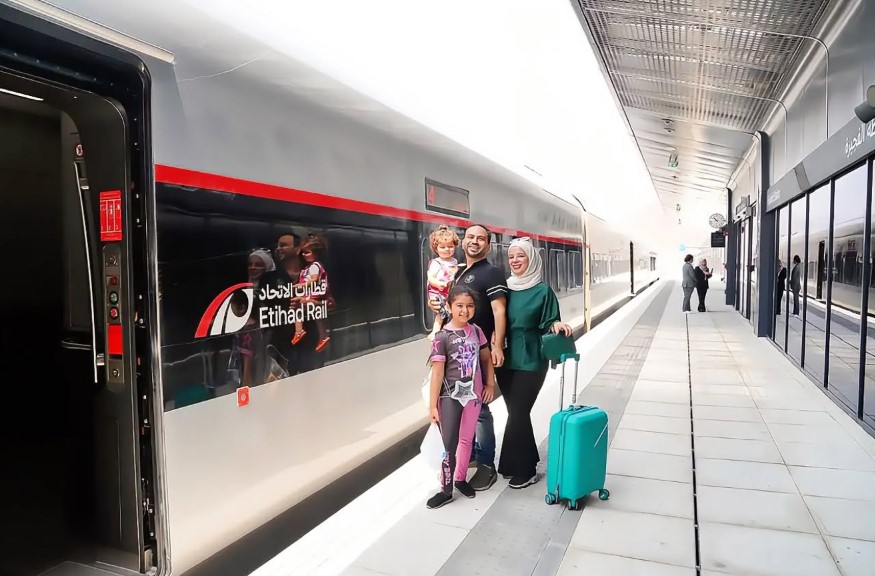
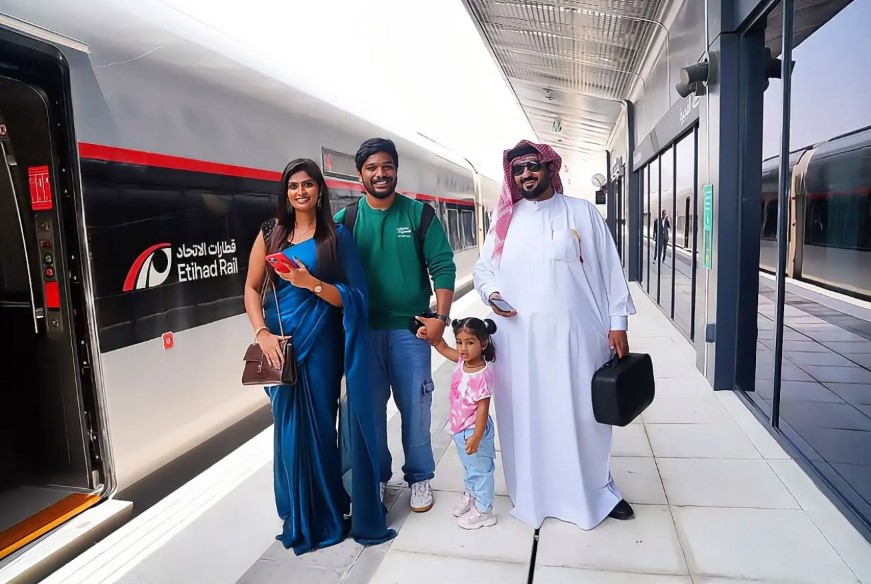
Domestically, the transformation is now visible on the ground. Etihad Rail’s passenger service officially began on 30 June 2026, connecting Abu Dhabi and Fujairah in one hour and 45 minutes, as the first stage of a national network that will eventually link 11 cities across the UAE. The wider passenger network is set to officially launch on 30 September 2026, with additional stations in Al Dhafra opening by December 2026. Freight, meanwhile, has been operating across the full network for several years, moving bulk cargo, containers, and industrial materials between ports, industrial zones, and logistics hubs.
The strategic logic, however, was never confined to domestic mobility. Etihad Rail was designed to connect the UAE to Saudi Arabia via Ghuwaifat in the west and to Oman via Al Ain in the east, opening new trade corridors for enterprises and travel opportunities that extend well beyond the country’s own geography. That cross-border ambition is now advancing on two fronts simultaneously — westward toward Saudi Arabia and the broader Arabian Peninsula, and eastward toward Oman and the Indian Ocean.
## Hafeet Rail and the First Cross-Border Link
The most tangible evidence of this expansion is Hafeet Rail, a joint venture linking the UAE to Oman. Hafeet Rail, a partnership between Etihad Rail, Oman Rail, and Mubadala, is constructing a 238-kilometre cross-border line from Sohar Port in Oman to Abu Dhabi, reported to be around 40 percent complete as of mid-2026. Once operational, the line is expected to dramatically compress travel times. Passenger trains are projected to cut travel time from Sohar to Abu Dhabi to just one hour and 40 minutes, and from Sohar to Al Ain to only 47 minutes, running at speeds of up to 200 km/h for passengers and 120 km/h for freight.
The significance of Hafeet Rail goes beyond convenience. Oman and the UAE signed a landmark agreement in 2023 to launch the Oman–Etihad Rail Company, tasked with linking Sohar and Abu Dhabi and giving the UAE its first fully integrated cross-border railway with another GCC state. Sohar Port opens directly onto the Gulf of Oman and the Arabian Sea — bypassing the Strait of Hormuz entirely. In an era where chokepoint security has become a first-order concern for shippers and governments alike, a rail-linked port outside Hormuz’s shadow gives the UAE, and by extension its trading partners, a hedge against exactly the kind of disruption that has repeatedly rattled regional shipping lanes.
## Toward Saudi Arabia and the Wider Gulf Railway
To the west, Etihad Rail’s link to Saudi Arabia represents the linchpin of the broader Gulf Railway project. Etihad Rail’s Stage Two infrastructure already reaches the Saudi border at Ghuweifat, and a passenger trial ran on the Saudi–UAE section during 2026 to test the physical connection, though scheduled cross-border freight interchange with the Saudi network is still being brought fully online.
That connection matters because Saudi Arabia is itself the fulcrum of a land bridge between the Gulf and the Red Sea. Once scheduled freight interchange with the Saudi rail network goes live, containers could move by rail from a UAE port toward the Saudi land bridge connecting the Gulf coast to the Red Sea — an overland alternative to sailing around the Arabian Peninsula altogether. For a region whose maritime chokepoints — Hormuz, Bab el-Mandeb, and the approaches to the Suez Canal — have all seen disruption in recent years, that overland alternative is not a convenience. It is increasingly viewed as strategic infrastructure.
Progress across the wider six-nation Gulf Railway has been uneven. The UAE and Saudi Arabia have advanced furthest, while Kuwait, Bahrain, and Oman have faced more significant delays; Qatar has built a modern rail network to GCC standards but remains unconnected to the broader system, and Bahrain has yet to build a national railway at all. Even so, momentum is building. The rail link between Saudi Arabia and Kuwait, announced in 2024, is scheduled to break ground in 2026, with the 650-kilometre corridor connecting Kuwait’s Al Shadadiya to Riyadh expected to be completed by 2028. Gulf states have also been signing fresh agreements to accelerate cross-border rail projects, with the Gulf Railway Authority setting December 2030 as its completion target for the unified six-country network.
Cost estimates for the full Gulf Railway run high. The project aims to connect Bahrain, Qatar, Kuwait, Oman, Saudi Arabia, and the UAE across more than 2,100 kilometres of track, with costs estimated between $100 billion and $125 billion. The payoff, proponents argue, is a genuinely integrated Gulf economy — one where goods, and eventually people, move across borders on rail rather than congested highways, at a fraction of the carbon cost. Etihad Rail estimates that Gulf rail transport could reduce road emissions by 21 percent annually by 2050, removing up to 300 trucks from the road for every train journey and cutting 8.2 million tonnes of CO2 emissions per year.
## Where Etihad Rail Meets the Middle Corridor
The phrase “New Silk Road” gets used loosely, but in the context of Etihad Rail it points to something specific: the growing overlap between Gulf rail infrastructure and the Trans-Caspian International Transport Route, better known as the Middle Corridor. The Middle Corridor connects China to Europe via Kazakhstan, across the Caspian Sea to Azerbaijan, then through Georgia and finally Türkiye. It was conceived as an alternative to Russia-transiting routes and China’s northern Belt and Road corridors — a way to move goods between Asia and Europe without passing through either Russian or Iranian territory.
The Gulf’s rail ambitions and the Middle Corridor are not competitors so much as complementary halves of a wider connectivity map. Where the Middle Corridor handles the Central Asian and Caucasus leg of Eurasian trade, Gulf rail — anchored by Etihad Rail — is positioned to handle the southern, maritime-adjacent leg, linking Indian Ocean shipping lanes to overland routes that bypass the Strait of Hormuz and reduce reliance on the Suez Canal. Both corridors respond to the same structural anxiety: that single-chokepoint dependency, whether at Hormuz, Bab el-Mandeb, or the Bosphorus, is no longer an acceptable risk for global supply chains.
This is also where Etihad Rail intersects with the India-Middle East-Europe Economic Corridor (IMEC), a parallel initiative unveiled in 2023. IMEC envisions a connectivity network running by sea from India’s western coast to the UAE, then by rail across Saudi Arabia and Jordan, before a maritime route carries goods into Europe. The corridor rests heavily on the UAE and Saudi Arabia’s seaports, roads, and logistics hubs, reinforcing both Gulf states’ roles as critical nodes in the emerging architecture of global trade.
IMEC’s path has not been smooth. The October 2023 Hamas attack on Israel and the subsequent regional turmoil divided key partners in the initiative, which depends on Saudi-Israeli normalization, progress toward Palestinian statehood, improved Saudi-UAE coordination, and unimpeded maritime traffic through the Strait of Hormuz — all factors that have slowed the project’s momentum considerably. Instability affecting Haifa port as IMEC’s Mediterranean entry point, along with the continued absence of Saudi-Israeli normalization needed for land transit across the Arabian Peninsula, has left the corridor’s western leg effectively stalled.
That uncertainty has, paradoxically, strengthened the case for Etihad Rail’s role. As IMEC’s Israel-dependent leg remains frozen, the Gulf’s own internal rail network — the UAE-Saudi-Oman-Kuwait grid taking shape independently of IMEC’s most contested segment — offers a connectivity pathway that does not hinge on the same geopolitical preconditions. Analysts note that IMEC can still contribute meaningfully to European supply-chain diversification even as the Middle Corridor draws the EU’s more immediate attention, particularly given security threats affecting the Bab el-Mandeb chokepoint and Red Sea transit routes. In that sense, Etihad Rail functions as connective tissue: a working, largely depoliticized rail asset that keeps Gulf integration moving forward regardless of which broader corridor concept — IMEC, the Middle Corridor, or some future hybrid — ultimately dominates the region’s trade geography.
## Geoeconomics of the Middle Corridor: Why It Matters Now
The urgency behind Middle Corridor development is not abstract. As conflict has disrupted established routes and dimmed the near-term prospects of IMEC’s western leg, the Middle Corridor has quietly continued its development roughly 3,500 kilometres to the north, positioning itself as an increasingly vital passageway for Eurasian trade. For the Gulf states, this dynamic creates both a challenge and an opportunity. The challenge is that a well-functioning northern corridor could, in theory, divert Asia-Europe freight away from Gulf ports and rail lines. The opportunity is that Gulf infrastructure — including Etihad Rail — can position itself as a southern feeder and redundancy layer, rather than a rival, to Central Asian and Caucasus routes.
This is precisely the geoeconomic logic that regional planners have begun to articulate: connectivity infrastructure is no longer just about efficiency, but about resilience through redundancy. A shipment that can move via the UAE-Saudi rail corridor to the Red Sea, via Omani ports outside Hormuz, or via a northern Middle Corridor route through the Caucasus, is a shipment far less vulnerable to any single point of disruption. Etihad Rail’s expanding cross-border links give the UAE a credible claim to being one of several southern anchors in that redundancy architecture — a role that, notably, does not require the resolution of the region’s most intractable political disputes to deliver value.
## Regional Cooperation as the Real Infrastructure
If there is a lesson embedded in the uneven progress of the Gulf Railway and the stop-start trajectory of IMEC, it is that steel and concrete are the easy part. The GCC railway’s implementation has been effectively stalled for more than 14 years, with delays driven less by engineering constraints than by financing gaps and uneven political will among member states. The technical capability to build these networks has never been seriously in doubt; the UAE’s own domestic rollout, completed and now operational, proves that. What has lagged is the harder work of aligning regulatory standards, customs procedures, financing structures, and diplomatic timetables across multiple sovereign states.
Etihad Rail’s own approach offers something of a template for how that cooperation can be built incrementally rather than all at once. Rather than waiting for a single grand multilateral agreement, the UAE has pursued a series of bilateral joint ventures — Hafeet Rail with Oman, technical interoperability trials with Saudi Arabia, and a steady stream of logistics partnerships with global freight operators. Etihad Rail has signed memoranda of understanding with a range of international and regional logistics firms, including Hellmann Logistics, HOYER Global Transport, Sharaf Logistics, Global Shipping and Logistics, Aramex, and DP World, each aimed at expanding the network’s cross-border and intermodal reach. Each individual agreement is modest. Collectively, they are stitching together the operational, commercial, and legal fabric that a purely government-to-government infrastructure treaty might take decades to negotiate.
This bilateral, building-block model may prove more durable than the more ambitious multilateral connectivity visions competing for attention in the region. IMEC promises transformational scale but depends on political preconditions — Saudi-Israeli normalization chief among them — that remain unresolved. The Middle Corridor requires sustained multinational coordination across Kazakhstan, Azerbaijan, Georgia, and Türkiye, each with its own domestic priorities. Etihad Rail’s expanding web of bilateral rail links, by contrast, advances regardless of the region’s broader diplomatic weather, because each link is negotiated and justified on its own commercial and logistical merits.
## What Comes Next
Three developments will determine how central Etihad Rail becomes to the emerging Eurasian trade map. First, the pace of Saudi-UAE freight interoperability: moving from trial runs to scheduled, commercial freight interchange would unlock the land bridge to the Red Sea that shippers have been anticipating for years. Second, the completion timeline for Hafeet Rail, which will give the UAE its first fully operational link to a non-Hormuz-dependent port. Third, the broader trajectory of the Gulf Railway Authority’s 2030 target — a deadline that, given the project’s history of delay, will test whether the recent burst of bilateral agreements can translate into genuine multilateral integration.
What is already clear is that Etihad Rail has outgrown its original brief as a domestic transport project. It has become the UAE’s principal instrument for embedding itself into the connective tissue of Eurasian trade — a role that does not require any single grand corridor to succeed, only that the Gulf keep laying track, signing agreements, and building the redundancy that a more volatile world now demands. In a region where the biggest connectivity projects have repeatedly stalled on politics, Etihad Rail’s incremental, bilateral approach may turn out to be exactly the kind of infrastructure diplomacy the New Silk Road actually needs.
About the Author