


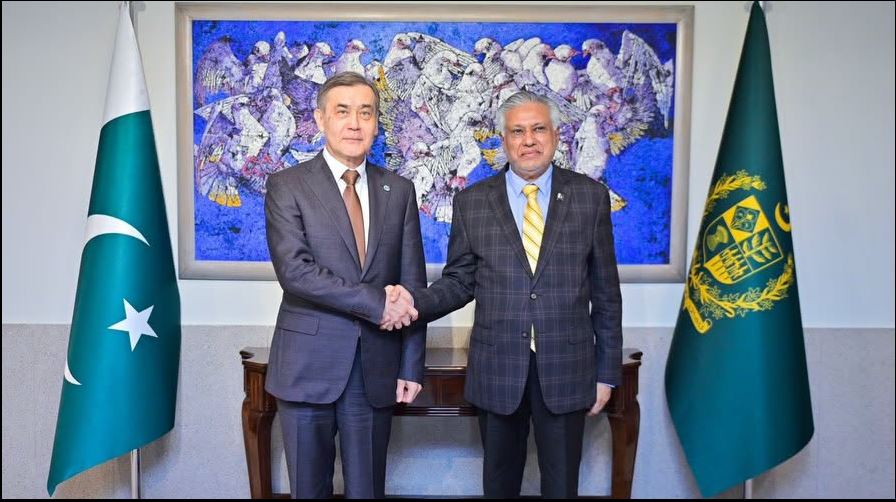
Deputy-Prime-Minister-and-Foreign-Minister-Senator-Mohammad-Ishaq-Dar-Receives-Secretary-General-of-the-Shanghai-Cooperation-Organization-SCO-Nurlan-Yermekbayev-in-Islamabad-Pakistan.
Deputy Prime Minister and Foreign Minister Senator Mohammad Ishaq Dar Receives Secretary-General of the Shanghai Cooperation Organization (SCO), Nurlan Yermekbayev in Islamabad, Pakistan.
By Muhammad Arif, Editor NSN.Asia
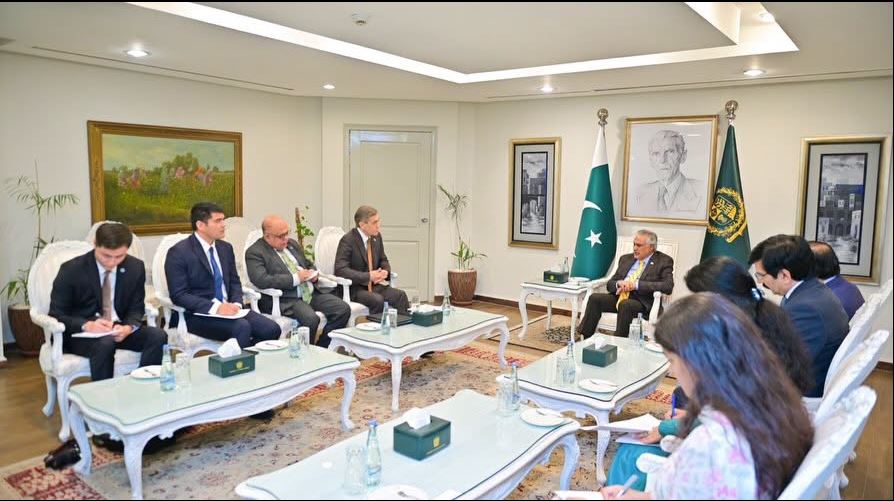
ISLAMABAD (NSN) — Deputy Prime Minister and Foreign Minister Senator Mohammad Ishaq Dar on Wednesday received Secretary-General of the Shanghai Cooperation Organization (SCO), Nurlan Yermekbayev, for wide-ranging discussions on strengthening regional cooperation, economic connectivity, and preparations for Pakistan’s upcoming leadership role within the organization.
The meeting underscored Pakistan’s growing engagement with one of the world’s largest regional organizations at a time when Islamabad is preparing to assume the Chairmanship of the SCO Council of Heads of State (CHS) in September 2026 and host the SCO Summit in 2027.
According to official sources, both sides held a productive exchange on the SCO’s priorities and explored practical ways to deepen cooperation among member states in key sectors, including trade, transport, connectivity, regional integration, and sustainable economic development.
The discussions also covered important regional and international developments affecting Eurasia and neighboring regions, reflecting the SCO’s increasing role in promoting dialogue, stability, and cooperative security.
Secretary-General Nurlan Yermekbayev appreciated Pakistan’s constructive contributions toward regional peace, stability, and multilateral cooperation. He acknowledged Islamabad’s active participation in SCO initiatives and highlighted the country’s important role in advancing regional connectivity and dialogue among member states.
During the meeting, the SCO Secretary-General also shared his perspectives on enhancing the organization’s institutional effectiveness and operational efficiency. He briefed the Deputy Prime Minister on preparations for the forthcoming SCO Council of Foreign Ministers (CFM) Meeting scheduled to be held in Bishkek, Kyrgyzstan.
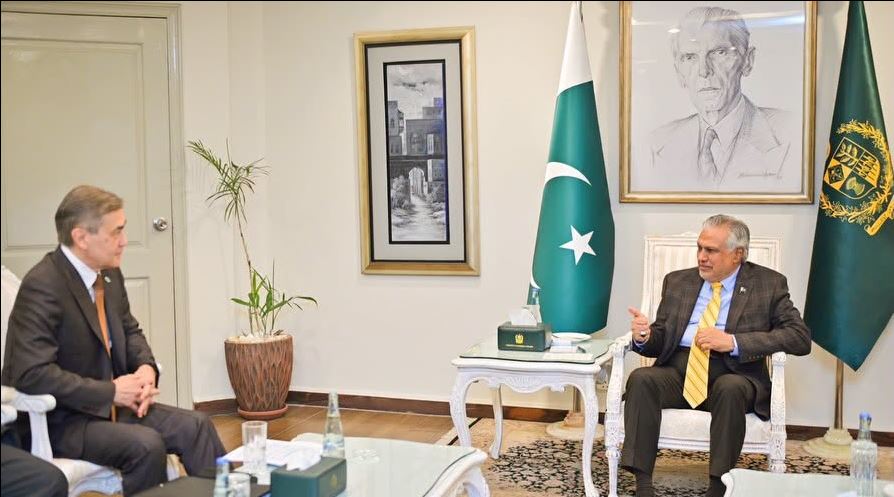
Deputy Prime Minister Ishaq Dar reaffirmed Pakistan’s unwavering commitment to advancing the objectives and principles of the Shanghai Cooperation Organization. He emphasized Pakistan’s readiness to work closely with all SCO member states in preparation for assuming the Chairmanship of the Council of Heads of State in September 2026 and successfully hosting the SCO Summit in 2027.
The meeting reflected Pakistan’s continued commitment to multilateral diplomacy and its strategic vision of promoting peace, connectivity, economic cooperation, and sustainable development across the wider Eurasian region.
Background: What is the Shanghai Cooperation Organization (SCO)?
The Shanghai Cooperation Organization is one of the world’s largest regional intergovernmental organizations, representing nearly half of the global population and a substantial share of the world’s economic output and landmass.
Established in 2001, the SCO evolved from the “Shanghai Five” mechanism, originally created to build confidence and resolve border issues among neighboring countries. Over the past two decades, the organization has transformed into a comprehensive platform addressing regional security, economic cooperation, trade facilitation, transportation, energy collaboration, cultural exchanges, digital transformation, and people-to-people connectivity.
The SCO currently includes:
- China
- Russia
- Pakistan
- India
- Kazakhstan
- Kyrgyzstan
- Tajikistan
- Uzbekistan
- Iran
- Belarus
The organization also maintains dialogue partnerships and observer relationships with numerous countries across Asia, the Middle East, and beyond, expanding its influence as an important Eurasian institution.
The SCO operates on the principles commonly referred to as the “Shanghai Spirit,” emphasizing:
- Mutual trust
- Mutual benefit
- Equality
- Consultation
- Respect for cultural diversity
- Pursuit of common development
These principles have enabled member states with diverse political systems, economic structures, and strategic interests to cooperate on shared regional priorities.
Pakistan’s Growing Role in the SCO
Pakistan became a full member of the Shanghai Cooperation Organization in 2017, marking a significant milestone in the country’s regional diplomacy.
Since joining the organization, Pakistan has actively participated in SCO ministerial meetings, security cooperation mechanisms, economic forums, cultural exchanges, and connectivity initiatives.
Islamabad views the SCO as an important platform for:
- Strengthening regional peace and stability
- Promoting economic integration
- Expanding trade with Eurasian markets
- Enhancing transport corridors
- Advancing energy cooperation
- Combating terrorism, extremism, and transnational crime
- Encouraging scientific, educational, and technological collaboration
Pakistan’s strategic geographic location makes it a natural bridge connecting South Asia, Central Asia, Western China, and the Middle East. This position aligns closely with the SCO’s long-term vision of improving regional connectivity through modern transportation networks and trade corridors.
Projects linked to the China-Pakistan Economic Corridor (CPEC), regional railway initiatives, digital connectivity, logistics infrastructure, and cross-border trade continue to reinforce Pakistan’s importance within the broader SCO framework.
Significance of Pakistan Assuming the SCO Chairmanship in 2026
Pakistan is scheduled to assume the Chairmanship of the SCO Council of Heads of State (CHS) in September 2026.
The Chairmanship represents one of the highest leadership responsibilities within the organization and provides Pakistan with an opportunity to shape the agenda of the SCO during its tenure.
As Chair, Pakistan will coordinate consultations among member states, facilitate consensus-building, oversee preparations for major meetings, and advance initiatives related to economic cooperation, regional connectivity, sustainable development, digital transformation, climate resilience, energy security, and cultural exchanges.
The Chairmanship will also allow Pakistan to highlight its vision for greater regional integration while promoting dialogue among member countries on shared challenges and emerging opportunities.
Diplomatic observers view the Chairmanship as an opportunity for Islamabad to strengthen its profile as an active stakeholder in Eurasian affairs and reinforce its commitment to multilateral diplomacy.
Pakistan to Host the SCO Summit in 2027
One of the most significant outcomes of Pakistan’s Chairmanship will be hosting the SCO Council of Heads of State Summit in 2027.
The summit will bring together Heads of State and Government from member countries, senior ministers, international organizations, and high-level delegations for discussions on regional cooperation and global challenges.
Hosting the summit is expected to provide Pakistan with several strategic advantages.
Diplomatically, the event will place Pakistan at the center of regional engagement by welcoming leaders representing some of the world’s largest economies and fastest-growing markets.
Economically, the summit could stimulate discussions on trade facilitation, investment, regional infrastructure, logistics, digital connectivity, transport corridors, and sustainable development initiatives.
The summit is also expected to showcase Pakistan’s hospitality, organizational capacity, security arrangements, and commitment to constructive regional cooperation.
In addition, the event is likely to attract significant international media attention, providing an opportunity to project Pakistan’s economic potential, investment opportunities, tourism, and strategic importance within Eurasia.
SCO’s Expanding Importance in a Changing Global Landscape
The Shanghai Cooperation Organization has steadily evolved into an influential platform addressing both traditional and emerging challenges.
Beyond security cooperation, member states increasingly focus on economic resilience, supply chain connectivity, digital innovation, climate adaptation, energy security, public health cooperation, food security, and sustainable infrastructure.
As geopolitical dynamics continue to evolve across Eurasia, the SCO offers an important forum where member countries can engage through dialogue rather than confrontation.
For Pakistan, active engagement within the organization complements its broader foreign policy objectives of maintaining balanced relations, promoting regional peace, encouraging economic diplomacy, and expanding partnerships with neighboring countries.
Looking Ahead
The meeting between Deputy Prime Minister and Foreign Minister Senator Mohammad Ishaq Dar and SCO Secretary-General Nurlan Yermekbayev highlighted the growing momentum in Pakistan’s engagement with the Shanghai Cooperation Organization.
With preparations underway for the upcoming Council of Foreign Ministers Meeting in Bishkek, Pakistan is entering a crucial phase as it prepares to assume the Chairmanship of the SCO Council of Heads of State in September 2026 and host the landmark SCO Summit in 2027.
These milestones present Islamabad with a unique opportunity to contribute to shaping the future direction of one of the world’s most influential regional organizations while advancing cooperation in connectivity, trade, infrastructure, sustainable development, regional peace, and shared prosperity.
As Pakistan works closely with fellow SCO member states, its leadership during the forthcoming Chairmanship is expected to reinforce the country’s commitment to constructive multilateral engagement and strengthen the organization’s role as a platform for dialogue, regional integration, and collective development across Eurasia.
About the Author