



Jakarta/NSN — The rapidly expanding global halal economy, now valued at more than US$7 trillion, presents one of the world’s largest untapped opportunities for trade, investment, industrial cooperation, and economic integration. With two of the world’s largest Muslim-majority nations—Pakistan and Indonesia—deepening economic engagement, experts believe both countries are uniquely positioned to emerge as strategic partners in shaping the future of the global halal ecosystem.
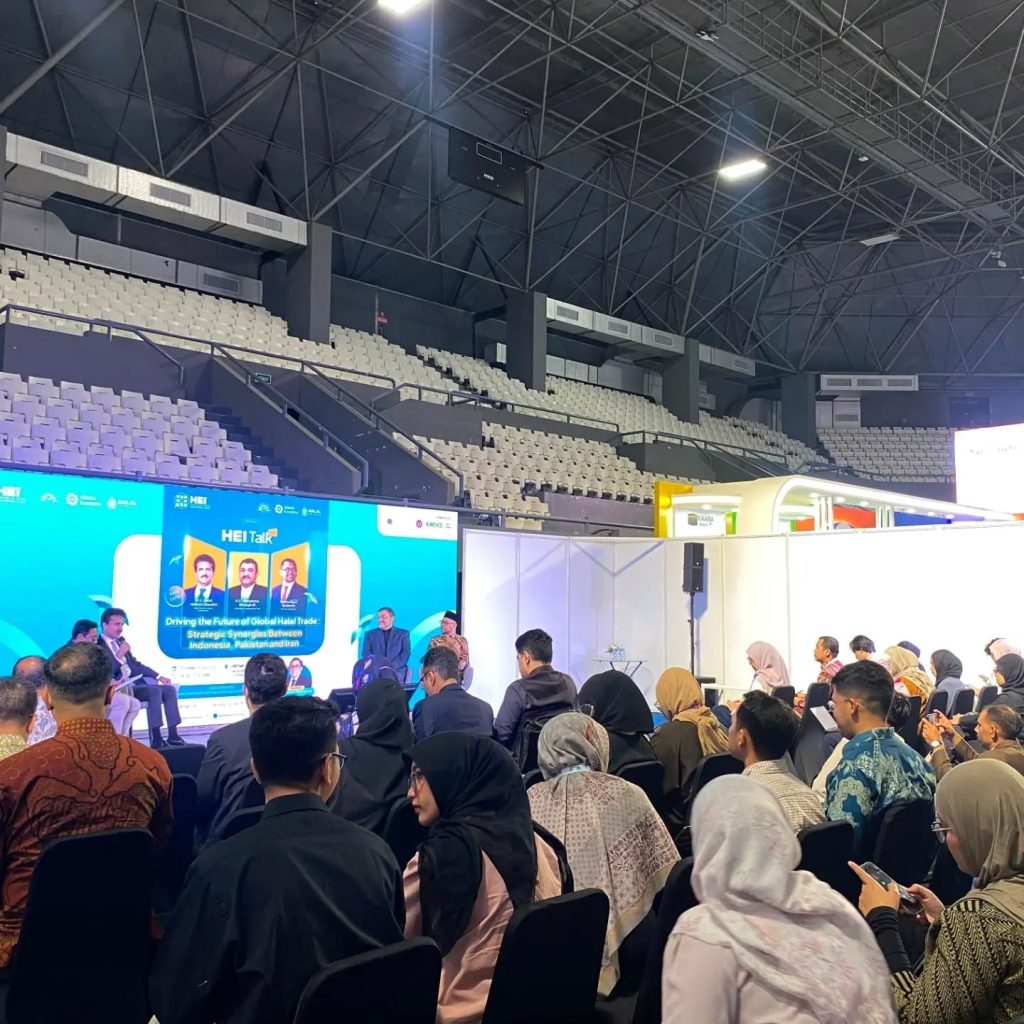
Speaking as a featured panelist during the D-8 Halal Expo Indonesia, Pakistan’s Ambassador to Indonesia, H.E. Zahid Hafeez Chaudhri, highlighted the enormous commercial potential of the international halal market, emphasizing that Pakistan is rapidly transforming into an emerging hub for halal manufacturing, agriculture, food processing, pharmaceuticals, Islamic finance, and value-added exports.
“The global halal economy has evolved into one of the fastest-growing sectors of international commerce, creating unprecedented opportunities for investment, innovation, and cross-border partnerships,” the Ambassador said.
He stressed that Pakistan offers significant untapped potential for international investors seeking access to expanding halal markets across South Asia, the Middle East, Central Asia, Africa, and beyond.
A US$7 Trillion Opportunity
The halal economy has grown far beyond its traditional association with food products.
Today, it encompasses an integrated economic ecosystem covering:
- Halal food and beverages
- Pharmaceuticals
- Cosmetics and personal care
- Islamic finance
- Fashion and textiles
- Tourism and hospitality
- Healthcare
- Logistics and cold-chain services
- Digital commerce
- Halal certification
- Biotechnology
- Food processing technologies
With the global Muslim population expected to approach three billion by 2060, demand for halal-certified products and services is projected to continue rising across both Muslim-majority and non-Muslim markets.
Consumers increasingly associate halal certification with quality assurance, food safety, ethical production, sustainability, and supply-chain transparency, making halal products attractive well beyond Islamic markets.
Pakistan’s Emerging Role in the Global Halal Industry
Ambassador Zahid Hafeez Chaudhri emphasized that Pakistan possesses many of the ingredients necessary to become a leading halal production and export hub.
Pakistan enjoys several strategic advantages:
- One of the world’s largest livestock populations
- A strong agricultural base
- Competitive food-processing industries
- Globally recognized pharmaceutical manufacturing
- Modern textile and leather sectors
- Expanding information technology capabilities
Strategic geographic location connecting South Asia, Central Asia, China, and the Middle East
Combined with improving halal certification systems and export-oriented industrial policies, these strengths position Pakistan to become a major supplier of halal products to international markets.
The country’s halal sector also aligns closely with national priorities of export diversification, industrial modernization, job creation, and attracting foreign direct investment.
Indonesia: The World’s Largest Halal Consumer Market
Indonesia occupies a unique position in the global halal landscape.
As the world’s largest Muslim-majority nation and Southeast Asia’s largest economy, Indonesia has developed an increasingly sophisticated halal ecosystem encompassing manufacturing, certification, Islamic finance, food processing, tourism, and digital innovation.
The Indonesian government’s commitment to becoming a global halal hub has accelerated investment in halal industrial parks, research institutions, certification infrastructure, and export promotion.
Its vast domestic market, combined with strong ASEAN connectivity, makes Indonesia an indispensable partner for countries seeking greater participation in the halal economy.
Pakistan and Indonesia: Natural Strategic Partners
Rather than competing, Pakistan and Indonesia possess highly complementary economic strengths.
Pakistan offers abundant agricultural resources, livestock, textiles, pharmaceuticals, surgical instruments, and food-processing capacity, while Indonesia contributes advanced halal certification systems, manufacturing expertise, consumer markets, logistics networks, and strong integration with ASEAN supply chains.
Together, they can establish one of the Islamic world’s most dynamic halal partnerships.
This cooperation can create integrated halal value chains extending from farms and factories to supermarkets and international consumers.
Building South Asia-ASEAN Halal Value Chains
During the D-8 Halal Expo Indonesia, Ambassador Chaudhri highlighted the importance of connecting South Asia with ASEAN markets through stronger commercial partnerships.
The Expo served as an important platform bringing together governments, investors, exporters, certification agencies, logistics providers, manufacturers, and technology companies.
For Pakistan, greater engagement with ASEAN represents an opportunity to diversify exports beyond traditional destinations while accessing one of the world’s fastest-growing consumer regions.
Indonesia can serve as Pakistan’s gateway into ASEAN’s more than 670 million consumers, while Pakistan provides Indonesia improved commercial access toward South Asia, Central Asia, and western China.
Expanding Bilateral Trade Through Halal Industries
Current Pakistan-Indonesia trade remains concentrated in palm oil, textiles, rice, chemicals, and manufactured goods.
The halal economy opens entirely new avenues for bilateral commerce.
Priority sectors include:
- Processed halal foods
- Meat exports
- Dairy products
- Rice and grains
- Pharmaceuticals
- Nutraceuticals
- Cosmetics
- Leather goods
- Islamic financial services
- Halal tourism
- E-commerce
These industries offer high-value export opportunities capable of significantly increasing bilateral trade over the coming decade.
Investment Opportunities
The halal economy is increasingly attracting international investors seeking stable, high-growth industries.
Pakistan offers investment opportunities in:
- Halal food processing
- Cold-chain logistics
- Agricultural technology
- Livestock development
- Pharmaceutical manufacturing
- Packaging industries
- Digital traceability systems
- Research and development
Indonesian companies can benefit from Pakistan’s competitive production costs and strategic geographic location, while Pakistani firms can leverage Indonesia’s established halal ecosystem and ASEAN market access.
Technology Driving the Halal Economy
Modern halal trade increasingly depends upon technology.
Emerging innovations include:
- Blockchain-based halal traceability
- Artificial intelligence for food quality monitoring
- Smart logistics
- Digital certification platforms
- QR-code verification systems
- E-commerce marketplaces
- Supply-chain analytics
Pakistan’s growing digital economy and Indonesia’s vibrant technology ecosystem provide fertile ground for collaborative innovation.
Joint ventures between technology companies can strengthen halal transparency and consumer confidence worldwide.

Harmonizing Halal Standards
One of the biggest challenges facing global halal commerce is the lack of harmonized certification standards.
Pakistan and Indonesia can play a leadership role by promoting:
- Mutual recognition of halal certificates
- Standardized regulatory frameworks
- Scientific testing laboratories
- Joint accreditation mechanisms
- Training programs for halal auditors
Greater standardization would reduce trade barriers while increasing international market confidence.
D-8: A Platform for Collective Leadership
The D-8 Organization for Economic Cooperation brings together eight major Muslim-majority developing economies whose combined population exceeds one billion people.
The D-8 Halal Expo demonstrates how member countries can collaborate to expand intra-D-8 trade, strengthen industrial partnerships, and develop integrated halal supply chains.
Pakistan and Indonesia, as influential D-8 members, are well positioned to lead initiatives that transform the organization into a major driver of the global halal economy.
Way Forward
To fully capitalize on the opportunities presented by the US$7 trillion halal economy, Pakistan and Indonesia should pursue a strategic roadmap:
- Upgrade bilateral trade cooperation with dedicated halal trade facilitation mechanisms.
- Establish a Pakistan-Indonesia Halal Business Council connecting exporters, investors, certification bodies, and chambers of commerce.
- Promote joint investment in halal industrial parks and food-processing zones.
- Develop integrated South Asia-ASEAN halal logistics corridors.
- Harmonize halal certification standards and pursue mutual recognition agreements.
- Encourage university partnerships focused on halal science, food technology, biotechnology, and Islamic economics.
- Expand cooperation in digital commerce, fintech, and blockchain-enabled halal supply chains.
- Organize annual Pakistan-Indonesia Halal Investment Forums under the D-8 framework.
- Launch joint branding initiatives to promote halal products in the Middle East, Africa, Europe, and Central Asia.
Conclusion
The global halal economy has evolved into a strategic engine of international trade, innovation, and sustainable development. Valued at more than US$7 trillion, it offers unprecedented opportunities for countries capable of building integrated production networks, trusted certification systems, and resilient supply chains.
The participation of Pakistan’s Ambassador, H.E. Zahid Hafeez Chaudhri, at the D-8 Halal Expo Indonesia reflects Islamabad’s determination to position Pakistan as an emerging halal production and investment hub. Equally, Indonesia’s globally recognized halal ecosystem and leadership within ASEAN make it an indispensable partner for realizing this vision.
By combining Pakistan’s agricultural strength, industrial capacity, and strategic location with Indonesia’s advanced halal infrastructure, large consumer market, and regional influence, the two nations can create a powerful South Asia–ASEAN halal corridor. Such a partnership would not only expand bilateral trade and attract investment but also strengthen food security, technological innovation, and economic resilience across the Islamic world.
As global demand for halal products and services continues to rise, Pakistan and Indonesia have a historic opportunity to move beyond traditional trade relations and jointly shape the future of the international halal economy—transforming shared values into shared prosperity.
About the Author