A Diplomatic Milestone Wrapped in Mango Season
Pakistan and China established diplomatic relations in 1951, and 2026 marks 75 years of what both governments routinely describe as an “All-Weather Strategic Cooperative Partnership.” Throughout the year, Pakistani missions across China — from Beijing to Guangzhou — have organised a series of cultural and trade events to commemorate the milestone, with mangoes emerging as an especially popular centerpiece. Earlier this month, the Pakistan Embassy in Beijing hosted a similar festival at Pakistan House, drawing hundreds of guests. The Guangzhou edition extended that celebration to southern China’s commercial hub, a region with deep and growing import ties to Pakistani agricultural produce.
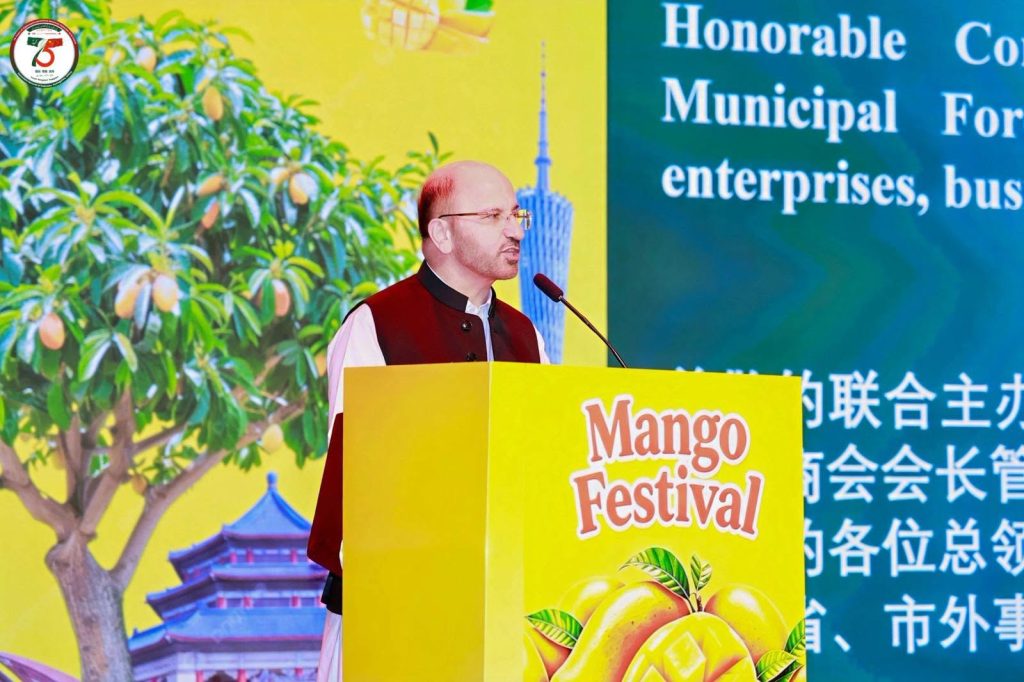
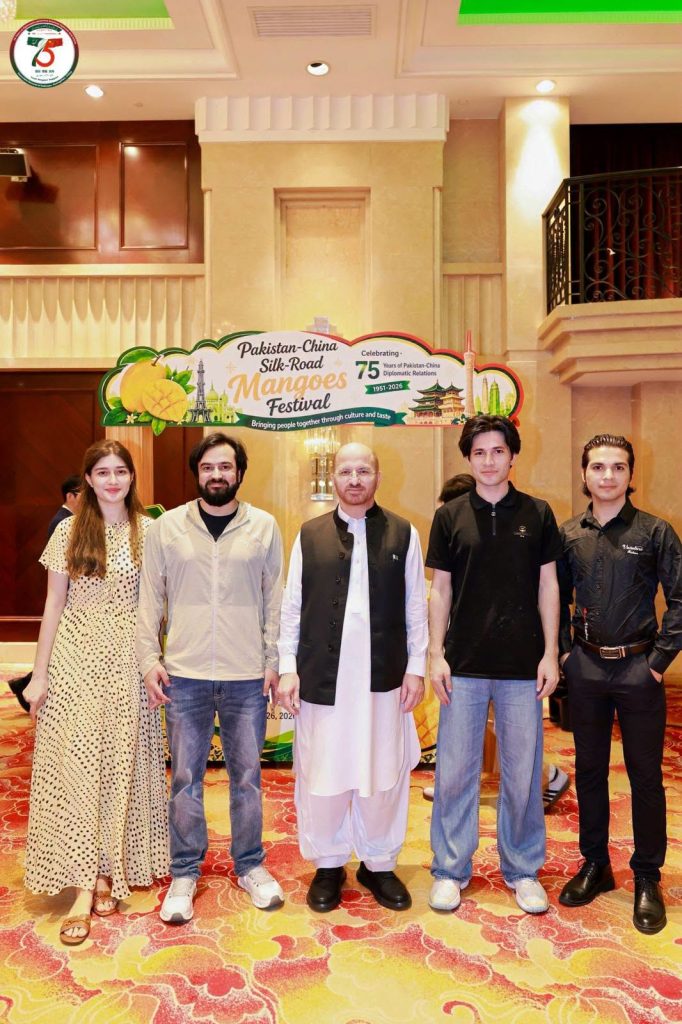
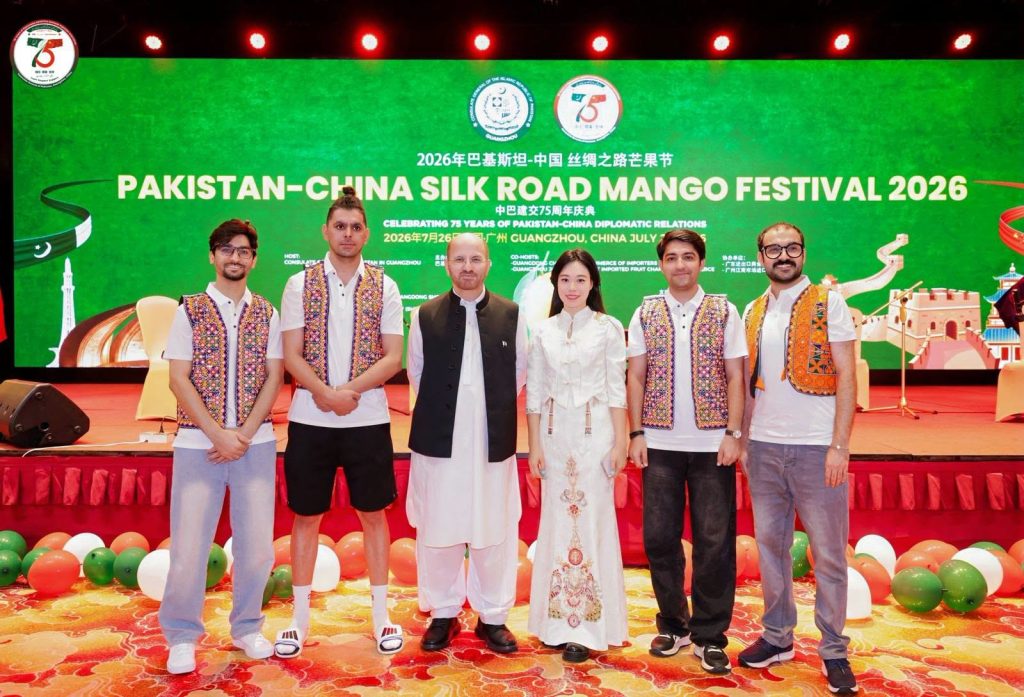
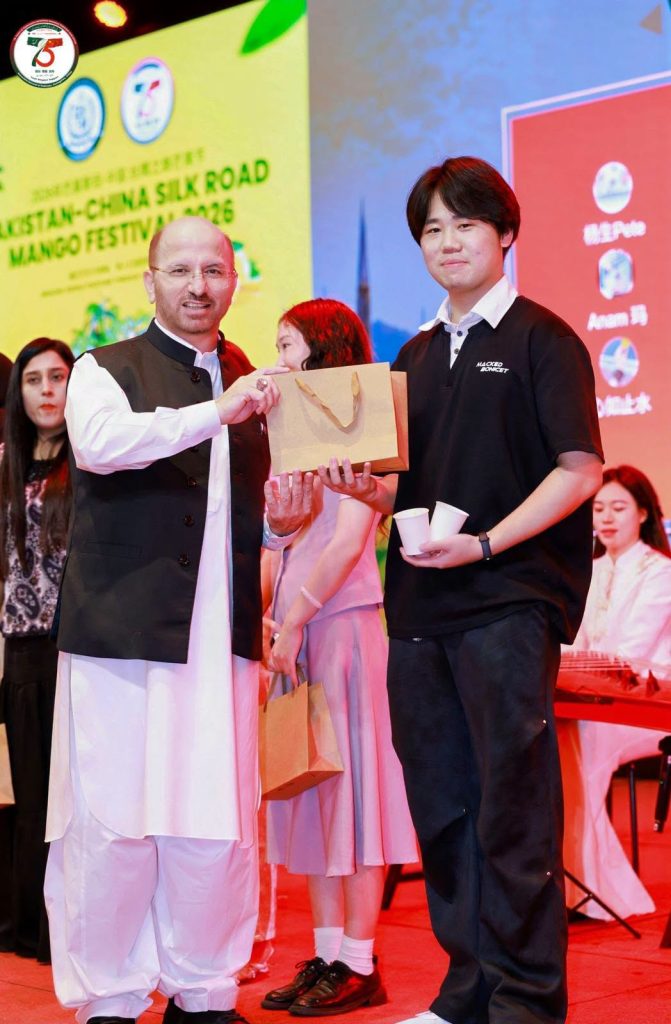
The Guangzhou event drew a wide cross-section of the city’s diplomatic and business community, including Consuls General, representatives of the Consular corps, officials from Foreign Affairs Offices, chamber of commerce leaders, entrepreneurs, scholars, students, and members of the local Pakistani community. The gathering reflected how food and trade diplomacy have become an effective bridge for building people-to-people ties alongside formal government engagement.
Mangoes as Ambassadors
Guests at the festival sampled a curated spread of Pakistan’s most celebrated mango varieties — Sindhri, Chaunsa, and Anwar Ratol — prized internationally for their fragrance, sweetness, and rich pulp. Beyond fresh fruit, the festival offered a range of mango-based creations, including mango milkshakes, mango yogurt shakes, mango custard, and mango ice cream, giving attendees a full sensory introduction to Pakistan’s mango culture.

Pakistan is among the world’s top mango producers, with orchards concentrated in Sindh and Punjab that have supplied the fruit to South Asian, Gulf, and increasingly Chinese markets for years. Chinese demand for Pakistani mangoes has grown steadily as trade facilitation and cold-chain logistics have improved, making events like this festival as much about commerce as culture. Local co-hosts, the Guangdong Chamber of Commerce of Importers & Exporters and the Guangzhou Jiangnan Market Imported Fruit Chamber of Commerce, represent exactly the kind of trade networks that move Pakistani produce into Chinese supermarkets and fruit markets, underscoring the festival’s dual purpose of celebration and commercial promotion.
Music, Performance, and a Shared Stage
Beyond the fruit tables, the festival featured cultural performances blending Pakistani and Chinese traditional music, offering guests a live demonstration of how the two nations’ artistic traditions can share a single stage. Such performances have become a recurring feature of Pakistan-China cultural diplomacy, reinforcing the idea that the relationship extends well beyond government offices and trade ledgers into classrooms, concert halls, and community gatherings.
Pakistan’s Deeper Roots on the Silk Road
The festival’s name is no accident. Pakistan’s geography places it at a historic crossroads of the ancient Silk Road, the network of trade routes that once linked China to Central Asia, Persia, the Indian subcontinent, and the Mediterranean world. Regions of present-day Pakistan — including Gilgit-Baltistan, the Karakoram corridor, and the Indus Valley — served as vital passageways for caravans moving silk, spices, textiles, and ideas between Chinese dynasties and civilizations to the west. The legendary Karakoram Highway, built in the twentieth century along ancient trade paths through the Himalayas, is often called the “modern Silk Road” for the way it retraces those same historic connections between the two countries.
That centuries-old exchange of goods and culture laid the groundwork for the deep trust that characterizes Pakistan-China relations today. From the Silk Road’s caravans to the China-Pakistan Economic Corridor, a flagship project connecting Gwadar Port to western China, the throughline is continuity: two civilizations repeatedly finding new routes, literal and symbolic, to reach each other. Framing a mango festival under the “Silk Road” banner deliberately draws on this history, positioning modern trade in fruit as a continuation of an exchange that predates the modern nation-state itself.
A Sweet Symbol of a Strategic Partnership
In remarks shared around the event, Pakistani officials described the relationship using an apt metaphor: like the mango, the All-Weather Strategic Cooperative Partnership between Pakistan and China is rooted in trust, nourished by cooperation, and ripened by the warmth of the people on both sides. It is a fitting image for a relationship that Pakistani officials frequently describe as “higher than the mountains and deeper than the oceans,” now recast in the more approachable language of shared meals and shared harvests.
Cultural Connectivity Through Cuisine
What events like the Silk Road Mango Festival ultimately reveal is that diplomacy often travels most effectively through a dinner table rather than a conference room. Food has a unique capacity to dissolve language barriers and formality, inviting people to experience another culture directly rather than simply hearing about it. When Chinese guests in Guangzhou tasted Sindhri and Chaunsa mangoes alongside Pakistani milkshakes and custards, they were not just sampling fruit — they were participating in a centuries-old tradition of culinary exchange that has connected China with South Asia since the earliest Silk Road caravans carried dried fruits, spices, and recipes alongside silk and porcelain.
This is why cuisine so often anchors cultural diplomacy: a shared meal creates common ground faster than a shared communique. Pakistani biryani nights in Chinese cities, Chinese culinary festivals in Pakistani universities, and now mango festivals like this one in Guangzhou all serve the same purpose — turning abstract diplomatic language about “friendship” and “partnership” into something tangible that people can taste, discuss, and remember. As Pakistan and China look toward the next 75 years of relations, it is this kind of cultural connectivity — built one mango, one dish, and one shared table at a time — that may prove just as enduring as any formal treaty.
]]>By: Muhammad Arif
Beijing: The 78th session of the UNGA, on July 1st, 2024 adopted by consensus the resolution “Enhancing international cooperation on capacity-building of artificial intelligence” proposed by China and co-sponsored by over 140 countries.
According to official sources, the resolution reflects the extensive consensus among countries on enhancing AI capacity-building, and speaks volumes about the political will of countries on enhancing capacity-building and bridging the AI divide through solidarity and cooperation.
The resolution, in line with the human-centric principle and the principle of artificial intelligence for good for all, is focused on AI capacity-building, stresses the importance of increasing the representation and say of developing countries in global AI governance, advocates a fair and nondiscriminatory business environment, supports the United Nations in playing a central role, encourages effective capacity-building assistance for developing countries through international cooperation and concrete actions, so as to realize the healthy and sustainable development of AI.
As the country that introduced the resolution, China followed the principles of transparency, openness, and inclusiveness during the discussions of the Resolution, widely accommodated legitimate opinions and suggestions, and strived to bridge the differences among all parties.
China’s efforts were spoken highly of by all the member states. The adoption of the resolution reflects that the international community and particularly developing countries are paying great attention to capacity-building, and have the strong will of actively participating in global AI governance.
China highly commends all the member states for their tremendous support for the resolution, and for their important contribution to its adoption.
China will take this adopted resolution as an opportunity to step up communication and cooperation with the international community, follow up on the implementation of the resolution, assist relevant countries in faster development of related capacities under the UN framework, so as to help achieve the UN Sustainable Development Goals for 2030 and jointly build a community with a shared future for mankind.
]]>By: Muhammad Arif
Paris: Ambasador Asim Iftikhar Ahmad on Tuesday inaugurated Pakistan Pavilion at the Texworld Apparel Sourcing Paris, being held in France, the fashion capital of the world.
Texworld Apparel Sourcing Paris till 3 July, 2024.
Pakistan Pavilion is showcasing attractive textile products of 12 exhibitors from Pakistan enthusiastic to work with international customers.

Pakistan Pavilion organized by Trade Development Authority of Pakistan and Pakistan Embassy’s Trade & Investment Section aims to project Pakistan’s prowess in textile world, and open new vistas of growth and development by facilitating B2B contacts with potential clientèle from France, and EU.
Alongside the global fashion event, Pakistan’s Ambassador to France, Asim Iftikhar Ahmad, attended MoU signing ceremony between Pakistan Business Forum of France, and International Business and Professional Corporation of Great Britain aimed at boosting commerce and trade activities and promoting Made in Pakistan Products in France.

Participants of appreciated the working of Special Investment Facilitation Council (SIFC) which is focused at facilitating overseas business community by providing conducive environment for investment and growth.
In order to benefit from the opportunities offered under one window SIFC, a delegation of prominent businessmen is likely to visit Pakistan to explore investment opportunities & promote Pakistan’s exports to Europe.

Texworld Apparel Sourcing Paris, a fashion industry event brought, being brought together leaders of fashion industry, apparel and textiles brands, besides the gathering of global fashion designers, innovators and entrepreneurs, showcasing their fashion products, discoveries, innovations and Initiatives.

The discussion forums of Texworld Apparel Sourcing Paris provided insights, highlighting the rising influences and dynamic changes of digitalization on the fashion landscape of world. The participants of the events got valuable insights from industry leaders as they explored the evolving strategies of fashion brands in response to ecological concerns, digitalization of supply chain management, innovative technology accelerates the production of climate-resilient, equitable, and sustainable cotton.

The event empowered brands owners to illuminate their universe of vibrant patterns and designs, and achieve their sustainability goals.
Colors and creativity at Texworld Apparel Sourcing Paris filled the air as participants embarked on a journey through textile excellence.
]]>By: Muhammad Arif
London: Saudi-listed ACWA Power, the world’s largest private water desalination company, and first mover into green hydrogen, has signed green financing agreements for Tashkent’s Riverside power plant in Uzbekistan with a financial of the USD533, ACWA Power stated on Monday.
Project includes a solar plant and the largest battery energy storage system (BESS) in Central Asia.
The total investment cost of the project is 2 billion Saudi Riyals, according to a statement issued by ACWA Power to the Saudi Stock Exchange (Tadawul).
Clean energy specialist, ACWA Power, said it wholly owns the Riverside Power Station project in Tashkent.
It added that ACWA Power Riverside Solar Energy Holding secured 1.4 billion Saudi Riyals for 19 years with the aim of developing, financing, designing, constructing and operating the power plant.
The funding it secured was provided by a consortium of development finance institutions, funds and international commercial lenders including the European Bank for Reconstruction and Development (EBRD), Proparco, DEG, Islamic Development Bank (IsDB), Standard Chartered Bank and KFW-IPEX Bank.
“In a world that is looking for greater participation of private capital in emerging markets to support growth and decarbonization, Uzbekistan is a case study under the vision and leadership of its Government and lenders like EBRD, DEG, Islamic Development Bank, Proparco, KfW-IPEX Bank and Standard Chartered,” said Chief Executive Officer of ACWA Power Marco Arcelli.
He added that the agreement for the Tashkent Riverside project reflects the strong trust placed in ACWA Power as the private sector partner, and one of the global leaders in renewables and energy storage.
“This trust is built on our unparalleled track record and we look forward to the successful execution of this new project to contribute to the country’s ambitious low carbon future,” Arcelli added.
Nandita Parshad, Managing Director of Sustainable Infrastructure Group at EBRD, said: “We are proud to partner with ACWA Power and co-financiers on the pioneering Tashkent Solar PV and energy storage project in Uzbekistan, the largest of its kind in Central Asia.”
“The project is core to Uzbekistan’s ambition to install 25GW of renewables by 2030. This project can power 170,000 households and the battery storage capacity is equivalent to 8000 electric vehicles.”
The project will play an instrumental role in achieving Uzbekistan’s ambitious targets to transition to a low-carbon economy as well as diversify its energy sources.
By 2030, Uzbekistan is aiming to generate 40% of its electricity from renewables.
The BESS will help to mitigate the effects of intermittency that are inherent in renewable energy sources, storing excess electricity generated during times of high production and make it available during periods of low production. This will ensure a constant and reliable supply of electricity to the grid, ultimately helping to meet the growing demand for energy in Uzbekistan.
Uzbekistan is ACWA Power’s second-largest market in terms of investments, underscoring the company’s long-standing commitment to the country. The company’s current portfolio in Uzbekistan now comprises 11.6GW of power, of which 10.1GW is renewable, as well as the Republic’s first green hydrogen project, with a capacity of 3,000 tons per year.
ACWA Power has recently signed a landmark $4.85 billion power purchase agreement (PPA) with the National Electric Grid of Uzbekistan for Central Asia’s largest wind farm — the Aral 5GW Wind Independent Power Producer (IPP) project in the Karakalpakstan region.
]]>This is stated in the article by Chinese President Xi Jinping “China and Kazakhstan: a common desire for new horizons”, who will visit Kazakhstan on a state visit on July 2-4.
“The economies of China and Kazakhstan complement each other in their structure and have great prospects for mutually beneficial cooperation. We will intensify the coupling of the joint implementation of the “One Belt, One Road” initiative with the promotion of the economic course of a fair Kazakhstan, expand access for Kazakhstani goods to the giant Chinese market to share China’s development opportunities. It is necessary to increase cooperation in such traditional areas as trade and economy, industry, investment, energy, mining and agriculture, the article says.
He also noted that it is necessary to increase the capacity of border crossings, contribute to improving the maintenance of China-Europe freight trains and the construction of the Trans-Caspian International Transport Route (TMTM) in order to improve the extensive network of transport connectivity.
It should be noted that during the visit, Xi Jinping will hold talks with President of Kazakhstan Kassym-Jomart Tokayev, and will also take part in the 24th meeting of the Council of Heads of State of the Shanghai Cooperation Organization (SCO), which will be held on July 3-4 in Astana.
Source: https://www.azernews.az/region/228094.html
]]>Located at the Xi’an Chanba International Port Park, the terminal was jointly constructed by the Xi’an Free Trade Port Construction and Operation Co and the KTZ (Kazakhstan’s railway company Kazakhstan Temir Zholy) Express Co. The development agreement was hailed as one of the most important cooperative achievements of the first China-Central Asia Summit, which was held in Xi’an in May last year.
Construction began on the terminal, which covers about 7 hectares, on May 18, 2023.
Equipped with warehouses and container storage areas, it is connected to the container handling area of the Xi’an Chanba International Port Park, which makes it an ideal site for the rapid pick-up and delivery of containers. It also provides added supply chain financial services, further reducing trade costs between China and Kazakhstan.
“The terminal can help facilitate the rapid distribution and allocation of goods for import and export between China and Kazakhstan, forming a commercial and trade logistics distribution center for Kazakhstan in China,” said Xie Tian, general manager of China-Kazakhstan (Xi’an) Commercial and Trade Logistics Co, which operates the terminal.
“On Oct 27, cooperation between the two nations was upgraded with the initiation of the construction of the China-Kazakhstan Logistics Terminal project in Almaty, the largest city in Kazakhstan,” Xie said.
“After its completion, it will further promote deeper, broader and more win-win cooperation between China and Kazakhstan,” he added.
Leveraging the strong momentum of the summit and harnessing its enormous dividends to deepen connectivity, the Xi’an Chanba International Port Park has established an efficient hub-to-hub logistics channel with an aim to inject vigorous energy into economic and trade cooperation between Shaanxi and Central Asian countries.
At the Xi’an branch of Beijing Neo-Safetrans International Co in the park, Li Jie, who works for the company’s railway operations department, uses the Chang’an Number Digital Comprehensive Service Platform online to schedule trains to travel to Almaty.
“On the platform, we can easily see the departure time of the Chang’an China-Europe freight trains and the status of slot reservations. Furthermore, through the platform, we can promptly obtain information regarding overseas operations, providing great convenience for our company in data entry at the front end and coordination with the KTZ Express,” she added. “More and more customers chose the Chang’an for its stable departure times and fast transportation efficiency,” she added.
Since last year, the company has explored a cooperative model for transporting complete sets of new energy vehicles and photovoltaic components from Xi’an to Kazakhstan and Uzbekistan, which has greatly expanded the variety of goods being transported by the company, according to its general manager, Li Ye.
“Thanks to the convening of the China-Central Asia Summit and the stable and high-quality operation of the China-Europe railway express, our customer base has increased by around 20 percent and our freight volume by 30 percent,” she said.
“Currently, the Xi’an-Almaty and Xi’an-Tashkent (in Uzbekistan) routes are the two largest in terms of freight volume. We are more confident that we can continue to deepen our presence in Central Asian countries.”
Since the service was launched in November 2013, the Chang’an China-Europe freight train service, which links Xi’an with destinations in Central Asia and Europe, continues to reduce costs, improve efficiency and provide excellent services. According to data released by China Railway Group, the line recorded 1,047 outbound trips in the first three months, a year-on-year increase of 16.7 percent.
Source: http://www.ecns.cn/business/2024-07-04/detail-ihecxmxh6563688.shtml
]]>These projects, poised to enhance both bilateral and regional connectivity, highlight the two countries’ commitment to strengthening ties, and evoke the region’s illustrious history as a crossroads of trade and culture.
NEW ROAD TRANSPORT ROUTE FOR ENHANCED CONNECTIVITY
According to an estimation by the World Economic Forum, 90 percent of global traded goods are shipped by ocean. Land-locked countries, however, do not have the opportunities for this cheaper form of trade.
As the largest land-locked country in the world, Kazakhstan has transcended its geographical limitation through extensive development of its transportation network. A crucial aspect of this transformation into a “land-linked” country is its Belt and Road cooperation with China.
On Wednesday, the two heads of state presided over the opening ceremony of a road transport route to a Caspian Sea port via video link, bolstering Kazakhstan’s efforts to improve its connectivity.
Though named “sea,” the Caspian Sea is the world’s larges inland body of water, surrounded by Kazakhstan, Russia, Turkmenistan, Iran, and Azerbaijan. Over the past few years, Kazakhstan has been modernizing its ports, crucial components of the Trans-Caspian International Transport Route (TITR).
The TITR begins at China’s port of Lianyungang and runs through Kazakhstan, the Caspian Sea, Azerbaijan, Georgia, and on to European countries. Gaidar Abdikerimov, secretary-general of the TITR International Association, noted that the route has become a vital artery for transporting goods from Southeast Asia and China to Europe.
Before the debut of Chinese trucks utilizing a road transport route to reach the Caspian Sea on Wednesday, China-Europe freight trains originating from China and crossing the Caspian Sea had already maintained seamless operations for two years.
Now, a comprehensive, multi-dimensional network integrating road, rail, air, and pipeline transportation has been established.
Noting that it was in Kazakhstan in September 2013 that Xi first proposed the initiative of the Silk Road Economic Belt, an essential component of the Belt and Road Initiative (BRI), Abdikerimov said that “this strongly inspired us and we are a significant part of the BRI.”
After more than a decade of development, the BRI has proven its feasibility and significantly impacted the development of the TITR, he said.
INCREASED CULTURAL EXCHANGE FACILITIES FOR BETTER TIES
In parallel with infrastructure developments, China and Kazakhstan on Wednesday enhanced “soft connectivity” through new cultural and educational projects.
Apart from attending the opening ceremony of the Chinese Culture Center in Astana and the Kazakh Culture Center in Beijing, the two heads of state also unveiled here the Kazakhstan Branch of Beijing Language and Culture University (BLCU).
Noting that Tokayev studied Chinese at BLCU from 1983 to 1984, BLCU’s President Duan Peng called the Kazakh leader “a brand ambassador for Chinese language and culture education at BLCU.”
Last October, when Tokayev visited his Chinese alma mater, he once again expressed his “sincere love for the Chinese people,” said Duan, adding that it was during that visit, Tokayev endorsed the proposal to establish a branch of the university in Kazakhstan.
According to Duan, the Kazakhstan branch will welcome its first cohort of 100 students this September, and the new branch plans to expand to a capacity of 800 students over the next five years, serving the entire Central Asia region.
Interest in the new school has been high, with numerous inquiries pouring in. For these new students, who will be Tokayev’s “new alumni,” Duan had this message: “We look forward to your successful studies here, making good friends, learning the Chinese language and culture well, and becoming bridges for the exchange and mutual learning between civilizations.”
Given the extensive shared border and the deepening partnership between China and Kazakhstan, particularly in transportation and logistics, there is a rapidly increasing demand in Kazakhstan for professionals proficient in Chinese, said Irsaliev Serik Aztaevich, president of Astana International University, where the BLCU Kazakhstan branch is located.
The new branch will focus on training high-level Kazakh-Chinese interpreters, with plans to expand its scope to train multilingual translators for the entire Central Asian region, he said, adding that Kazakhstan’s demand for highly skilled professionals fluent in Chinese is growing swiftly.
Emphasizing that young people are the inheritors of China-Kazakhstan friendship from generation to generation, Xi, in his meeting with Tokayev on Wednesday, called for the two countries to give full play to the role of the culture centers and the Kazakhstan Branch of BLCU.
He urged these institutions to strengthen cultural exchanges, enhance mutual understanding between the two peoples, especially the young generation, and strengthen public support for all-round cooperation between the two countries.
CHINA’S COMMITMENT TO REGIONAL CONNECTIVITY
Xi arrived in Kazakhstan on Tuesday for a state visit and to attend the 24th Meeting of the Council of Heads of State of the Shanghai Cooperation Organization (SCO).
“President Xi’s visit to Astana for the SCO summit is of significant importance and influence, because it underscores China’s commitment to regional cooperation,” said Gulnar Shaimergenova, director of Kazakhstan’s China Studies Center.
“It (The visit) enhances diplomatic ties, promotes economic cooperation, and strengthens the unity and effectiveness of the SCO,” she said.
“President Xi’s presence at the summit highlights China’s vision for a more interconnected and prosperous region,” Shaimergenova concluded.
China’s commitment to enhancing connectivity extends beyond its bilateral relations with Kazakhstan. Under the BRI, China is spearheading numerous infrastructure projects across Central Asia for win-win cooperation and common prosperity across the region.
A prime example is the agreement on constructing the China-Kyrgyzstan-Uzbekistan railway, reached in early June. Once completed, this railway will significantly shorten the time required to transport Central Asian products to major global markets. It will also facilitate the integration of Central Asia into global industrial and supply chains, thereby boosting regional development.
]]>By: Muhammad Arif, Editor NSN.Asia
Islamabad: Chinese leader Xi Jinping and Russian President Vladimir Putin have reiterated their commitment to advance their vision for common development of Eurasian countries through win-win cooperation under the Shanghai Spirit at Astana Summit 2024 that concluded in capital of Kazakhstan, on July 3, 2024, where heads and envoys of 10 member states gathered to discuss matters pertaining to mutual security, stability, peace, and common economic development.
The annual summit of SCO in Astana showed that Beijing and Moscow have aligned their mutual interests for common security, peace and development amid the regional geopolitical tensions as Western institutions bombard them by various trade and economic sanctions.
China and Russia are the main drivers behind the SCO’s expansion, and both are seeking more engagement with Central Asian, Eurasian and South Asian partners based on the principle of ‘Good Neighbourliness’ , peaceful coexisting and mutual benefit for all.
Both the founding states, China and Russia, aspire to present the SCO as a platform for dialogue and cooperation that has become a dynamic organization that other regional countries like Turkiye have forwarded requests for admission or membership.
The charismatic alignment of Xi and Putin has always stressed the need to jointly promote SCO as a sphere for dialogue and communication, a pathway for scientific and technological innovation, a force for maintaining the regional peace and stability, and as an icon of Eurasian integration and connectivity.
While attending the expanded meeting of the Shanghai Cooperation Organization SCO+, Chinese President Xi Jinping said “China is ready to work with all parties to implement the eight major steps under high-quality Belt and Road cooperation and promote regional cooperation through platforms, such as the demonstration base for agricultural technology exchange and training, the local economic and trade cooperation demonstration area, and the ecology and environment innovation base”.
Xi called for earnest efforts to establish an SCO financing platform and welcomed all parties to use the BeiDou Navigation Satellite System and participate in constructing the international lunar scientific research station.
China is ready to provide no less than 1,000 training opportunities for digital technology in the next three years, he said.
Shanghai Cooperation Organization is bedrock of multipolar world, said Russian President Vladimir Putin during a meeting with Chinese President Xi Jinping on Wednesday at the SCO summit in Astana, Kazakhstan.
“The Shanghai Cooperation Organization (SCO) is expanding to become a power center in a world that is evolving towards multipolarity”, Putin noted.
Putin also promised to support China’s chairmanship of the SCO in 2024–2025 in “every way,” calling the organization “one of the key pillars of a fair multipolar world order.”
“We have repeatedly stated with good reason that Russia-China relations, our comprehensive partnership and strategic cooperation, are going through the best period in their history,” the Russian leader said. They are “guided by the principles of equality, mutual benefit and respect for each other’s sovereignty,” Putin stressed in his statement.
Our cooperation is not directed against anyone. We do not create any blocs or alliances; we are simply acting in the interests of our people”, he added.
Belarus officially joined the Shanghai Cooperation Organization (SCO) on Thursday during the Astana Summit, and became its 10th member state of SCO’s ‘big family’, adding a new chapter of cooperation among Eurasian states.
After the summit in Astana, China is due to take up the rotating presidency of the SCO for a year.
SCO was founded in 2001 by China, Russia, Kazakhstan, Kyrgyzstan, Tajikistan and Uzbekistan to combat terrorism and promote border security, the SCO has grown in recent years in line with Beijing and Moscow’s shared vision to build a community of shared future; peace for all and development for all.
- Indian Prime Minister Narendra Modi skipped the event this time.
“The SCO has become one of the most authoritative international organizations, and given the uniqueness and enormous potential of the SCO, interest from other countries in joining the organization is steadily growing”, Belarusian President Alexander Lukashenko said during the summit.
- Astana Declaration calls for building a community with a shared future for mankind
The Astana summit concluded in Kazakhstan, and members of SCO adopted the Astana Declaration who reaffirmed their commitment to building a new type of international relations and a community with a shared future for mankind.
- Astana Declaration called on SCO members to oppose a confrontational mindset in resolving international and regional issues.
- Qingdao City declared as SCO tourist and cultural capital for 2024 and 2025
Qingdao City, located in Shandong Province of China, has been declared as will be the SCO tourist and cultural capital for 2024 and 2025, the Astana Declaration stated.
- SCO members agree to promote multilateral trading system
The SCO members agreed to promote multilateral trading system for the building of an open world economy.
Shanghai Cooperation Organization (SCO), covering more than 60 percent of the Eurasian continent and nearly half of the world’s population, would provide a strategic opportunity for regional land and sea transport corridors to play a vital role for Eurasian connectivity, cooperation and development.
- Astana Summit 2024 consolidates global standing, appeal and attractiveness of SCO
Admitting Belarus as an official member further consolidates global standing, appeal and attractiveness of SCO as regional hub of cooperation.
The SCO was founded in 2001 with six original members, it expanded by including India and Pakistan in 2017 and Iran in 2023. In 2024 at Astana Summit, it added Belarus as its current 10 members that leads the SCO to be the world’s largest regional organization in terms of territorial expanse and population, covering over 40 percent of the world population.
As of 2023, its combined GDP accounted for over a quarter of the global GDP, while the establishment of a legal framework as well as various cooperation mechanisms has boosted economic integration between the member states.
SCO’s expansion shows widening spectrum of cooperation and connectivity across Asia, Europe and the Middle East, reflecting significant benefits for the member states in their efforts to develop transportation infrastructure and promote regional connectivity for the prosperity.
- The leaders of SCO countries sign cooperation agreements during the Astana Summit.
The leaders of the ten countries of the Shanghai Cooperation Organization (SCO); China, India, Iran, Kazakhstan, Kyrgyzstan, Pakistan, Russia, Tajikistan, and Uzbekistan, and Belarus also signed dozens of cooperation agreements during the Astana Summit.
Astana declaration shows various cooperation initiatives and joint efforts for development of innovative payment systems, e-commerce infrastructure, digital economy, countering economic monopolization, sustained development, environmental protection, green energy development, atomic energy, tourism, healthcare, waste management etc.
- Upholding the Shanghai Spirit of mutual cooperation, mutual trust and good neighborliness
If 10 member states of SCO continue to uphold the Shanghai Spirit of mutual cooperation, mutual trust and good neighborliness, I am sure they could accomplish the Eurasian dream of common prosperity, and development.
]]>“Yesterday, we joined an online experts meeting from both countries to discuss the similar challenges of desertification and possible solutions based on technology and innovative policies,” the diplomat said.
Bistritsky added that with the COP29 presidency, they agreed to promote joint side events during the summit that will take place this year in Baku.
]]>Topping the agenda are priorities like improving data infrastructure and relevant institutional systems and promoting market-oriented allocation of data resources.
Given the far-reaching impact of the digital economy, emphasis should be placed on comprehensively integrating these technologies with the real economy, so as to provide a solid underpinning for economic and social development, according to the State Council executive meeting chaired by Premier Li Qiang.
China’s total data output reached 32.85 zettabytes in 2023, up more than 22 percent year-on-year, while the added value of core digital economy industries accounted for 10 percent of GDP, according to the National Data Administration.
On Tuesday, during the Global Digital Economy Conference 2024, Liu Liehong, head of the administration, said that China is set to prioritize relevant institutional reforms this year, aiming to unleash the potential of the country’s vast data resources and transform them into a new competitive advantage.
The administration plans to roll out eight institutional documents, focusing on data property rights, data circulation, revenue distribution, security governance, public data development and utilization, enterprise data development and utilization, high-quality development of the digital economy, and data infrastructure construction, Liu said.
The rapid development of China’s digital industries came on the back of robust digital infrastructure. Recent statistics from the Ministry of Industry and Information Technology showed that the country had built 3.837 million 5G base stations by the end of May, accounting for 60 percent of the global total.
Friday’s meeting also announced that efforts will be made to enhance the innovation capabilities of platform companies and promote the sustained and healthy development of the platform economy.
The platform economy has emerged as a vital force both in facilitating connectivity between the digital and real economies and in driving the development of the real economy, according to a report by the China Academy of Information and Communications Technology.
The market value of China’s platform economy surged from 4.97 trillion yuan ($683.90 billion) in 2015 to 33.43 trillion yuan in 2022, with a compound annual growth rate of 32.92 percent. Furthermore, by the end of 2022, the number of Chinese platform unicorns — enterprises valued at over $1 billion — reached 254, marking an increase of 190 companies compared to 2015.
]]>