



Marco Polo's Silk Road Journey The 10,000 KM Voyage from Venice to Beijing 1
Marco Polo’s legendary 13th-century Silk Road journey tracing the trail of bazaars, mountains, and lost caves.
Tracking the interconnected world of the Silk Road
- Silk Road
Marco Polo’s Silk Road Journey: The 10,000-Kilometer Voyage from Venice to Beijing
How a 13th-century Venetian merchant’s overland trek reshaped Europe’s understanding of the Far East — and left behind a trail of bazaars, mountain passes, and desert caves still standing today.
Background
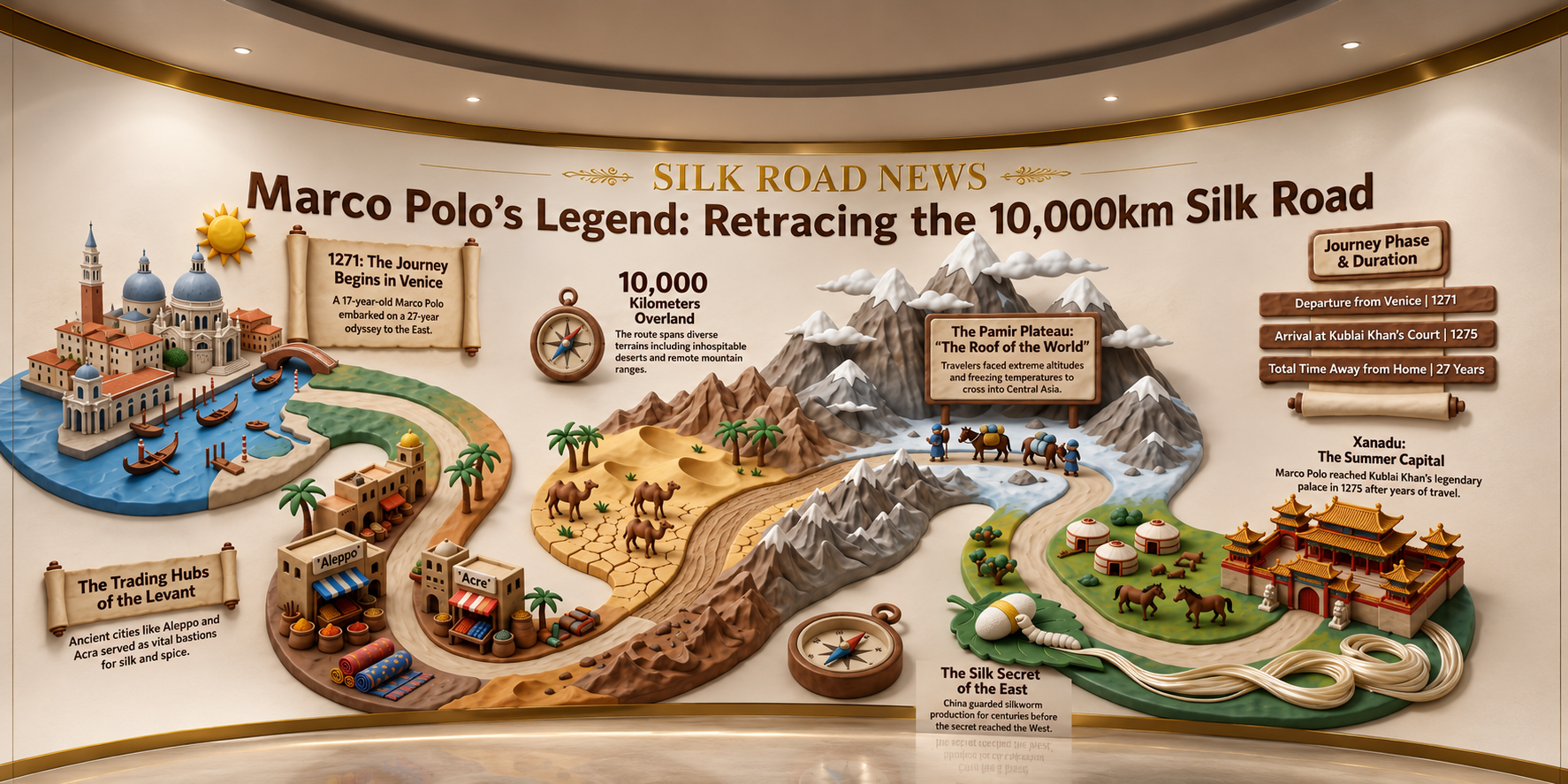
In 1271, a 17-year-old Venetian named Marco Polo left the canals of his home city with his father Niccolò and uncle Maffeo, bound for the court of the Mongol emperor Kublai Khan. What followed was a nearly four-year overland odyssey spanning roughly 10,000 kilometers — through the Levant, the Persian plateau, the high passes of Central Asia, and the deserts of western China — before reaching the glittering Yuan Dynasty capital of Khanbaliq, present-day Beijing.
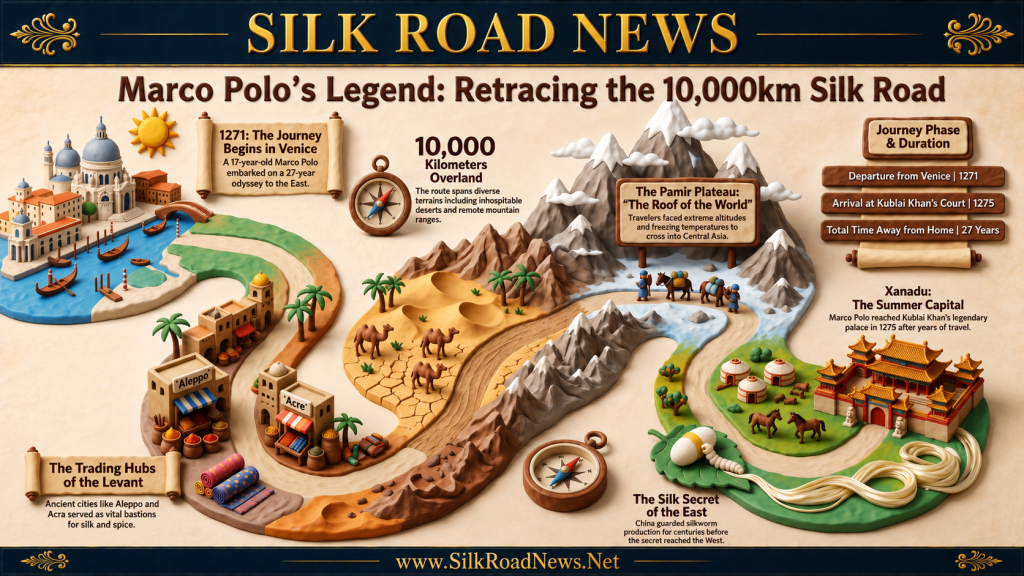
Marco Polo would spend nearly 17 years in the service of the Mongol court before returning home. His account of the journey, later dictated in a Genoese prison and published as The Travels of Marco Polo (also known as Il Milione), became one of the most influential travel narratives in European history. It introduced the West to paper currency, coal, and the scale and sophistication of Chinese cities — planting the seeds of the Age of Exploration that followed two centuries later.
Today, the route Polo traveled remains one of the world’s richest heritage corridors, recognized by UNESCO as part of the Silk Roads network of sites connecting Europe and East Asia.
Timeline of Marco Polo’s Journey Along the Silk Road
1271 — Departure from Venice
The Polo family departs Venice by ship, crossing the Mediterranean toward the Levantine coast, carrying a letter from Pope Gregory X to Kublai Khan.
Israel and the Levantine Coast
The travelers pass through the Holy Land region, then under Crusader and Mamluk influence, gathering holy oil from Jerusalem that Polo’s account notes was intended as a gift for the Khan.
Syria — The Bazaars of Aleppo
Moving inland, the party reaches Aleppo, then one of the great commercial hubs of the Islamic world. Its covered souks — among the oldest and largest covered markets on Earth — were already centuries old, trading in spices, textiles, and metalwork from across three continents. Sections of Aleppo’s historic souks, though damaged in recent conflict, remain a UNESCO World Heritage Site and a symbol of the city’s trading legacy.
Iran — Crossing the Persian Plateau
The route continues through Persia, via cities such as Tabriz, Kerman, and Hormuz, where Polo documented silk and textile production, desert caravanserais, and the region’s famed carpet weaving traditions — craft economies that had sustained Silk Road trade for a millennium.
Afghanistan — The Pamir Passes
Polo’s account describes crossing the rugged terrain of Badakhshan in present-day Afghanistan, noting local lapis lazuli and ruby mining. This is widely regarded as the gateway to the “Roof of the World.”
Tajikistan — The Pamir Mountains
The expedition traverses the Pamir Mountains, among the most physically demanding legs of the entire route. Polo’s descriptions of the high, cold plateau are considered among the earliest European accounts of this remote mountain range, later dubbed “Marco Polo sheep” territory after the wild argali sheep he documented there.
Western China — The Ancient Caves of Dunhuang
Descending into the Taklamakan Desert and the Hexi Corridor, the party reaches Dunhuang, a critical Silk Road oasis. The nearby Mogao Caves — a complex of Buddhist grottoes filled with murals and manuscripts dating back over a thousand years — stood as a spiritual and artistic crossroads where Chinese, Central Asian, and Indian traditions merged. The site is now a UNESCO World Heritage location.
Jade and Silk Along the Corridor
Traveling through Khotan and the Hexi Corridor, Polo recorded local jade mining traditions and silk-weaving workshops, industries that had defined the region’s identity and export economy since antiquity, and that historians still reference when verifying the accuracy of his accounts.
1275 — Arrival in Khanbaliq (Beijing)
After roughly three and a half years of travel, the Polos reach Kublai Khan’s summer capital and eventually Khanbaliq, the Yuan Dynasty capital that would become modern Beijing. Marco Polo is received into the Khan’s court, beginning a period of service that included travels throughout the empire, including to the southern city of Hangzhou.
Hangzhou — “The City of Heaven”
Polo’s writings describe Hangzhou, then possibly the largest and wealthiest city on Earth, with striking admiration — its canals, bridges, and markets leading him to call it the finest and most splendid city in the world. His account helped cement Hangzhou’s reputation in the European imagination long before any other Westerner had seen it.
1295 — Return to Venice
After nearly 17 years away, Marco Polo returns to Venice. His later account of the journey, dictated during captivity in Genoa, would go on to shape European geography, cartography, and ambition for centuries.
Historical and Architectural Significance
The route Polo traveled is not a single road but a network of trade corridors linking dozens of civilizations. Its surviving landmarks — Aleppo’s souks, the Mogao Caves of Dunhuang, the caravanserais of Persia, and the canal cities of southern China — represent one of the most architecturally diverse heritage systems in the world, blending Islamic, Buddhist, Persian, and Chinese design traditions shaped entirely by centuries of trade rather than conquest.
Many of these sites now hold UNESCO World Heritage status, and modern “Silk Road” tourism and heritage-preservation initiatives across Central Asia and the Middle East continue to draw on Polo’s account as a reference point for reconstructing the routes and rhythms of medieval trade.
Conclusion: Silk Road Memories
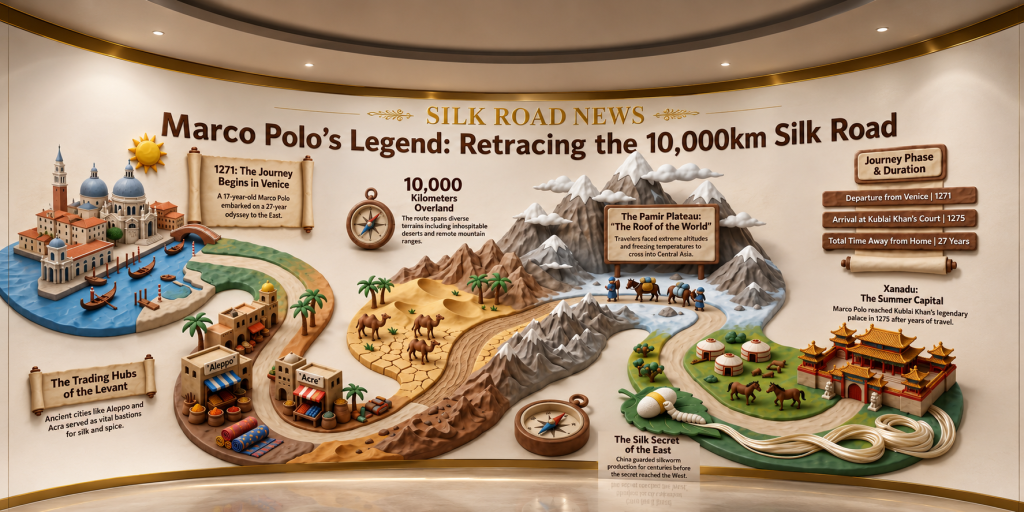
More than 750 years after Marco Polo set out from Venice, his journey remains a benchmark for understanding how trade, faith, and curiosity connected the medieval world. The bazaars of Aleppo, the passes of the Pamirs, the caves of Dunhuang, and the canals of Hangzhou endure — some restored, some fragile, all carrying the memory of a road that was never really about silk alone, but about the exchange of ideas between civilizations. Polo’s account, however embellished by later retellings, remains the clearest thread connecting Europe’s medieval imagination to the vast, interconnected world of the Silk Road — a legacy still walked, studied, and preserved today.
About the Author