



China-Europe Railway Express and Revival of the New Silk Road
By NSN News Desk
The China-Europe Railway Express (CRE) has emerged as one of the most significant logistics achievements of the 21st century, reshaping the economic geography of Eurasia by connecting manufacturing hubs in China with consumer and industrial markets across Europe through Central Asia, Russia, the Caucasus, and beyond.
Once viewed as an ambitious component of China’s Belt and Road Initiative (BRI), the railway network has evolved into a mature international freight corridor carrying millions of tons of cargo annually. It has shortened transportation times, diversified supply chains, strengthened regional integration, and revived the historical spirit of the ancient Silk Road through modern rail infrastructure.
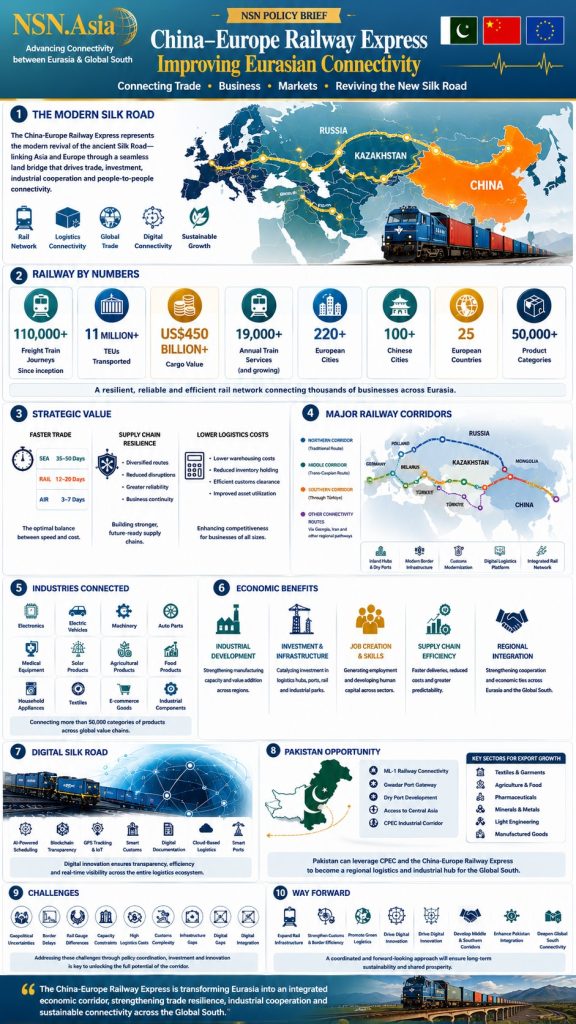
Today, the China-Europe Railway Express is more than a transport network—it is a strategic economic corridor linking industries, businesses, logistics providers, ports, customs authorities, and financial institutions across dozens of countries.
As global supply chains continue to diversify following the COVID-19 pandemic and ongoing geopolitical uncertainties, the China-Europe Railway Express has become increasingly important for ensuring resilient, efficient, and sustainable trade between Asia and Europe.
A Modern Revival of the Ancient Silk Road
More than two thousand years ago, the Silk Road connected China with Central Asia, Persia, the Middle East, and Europe, facilitating not only trade but also cultural exchanges, scientific discoveries, and diplomatic relations.
The China-Europe Railway Express represents the modern version of that historic route.
Instead of camel caravans carrying silk, spices, and porcelain, today’s freight trains transport:
- Electronics
- Electric vehicles
- Machinery
- Auto parts
- Medical equipment
- Solar products
- Household appliances
- Textile products
- Industrial components
- E-commerce goods
- Agricultural products
- Food products
Running through multiple international corridors, these trains have become the backbone of the Silk Road Economic Belt, the land component of the Belt and Road Initiative.
Rapid Growth Since Launch
The first China-Europe Railway Express departed from Chongqing in 2011.
Few observers expected that within little more than a decade the network would become one of the world’s busiest international freight rail systems.
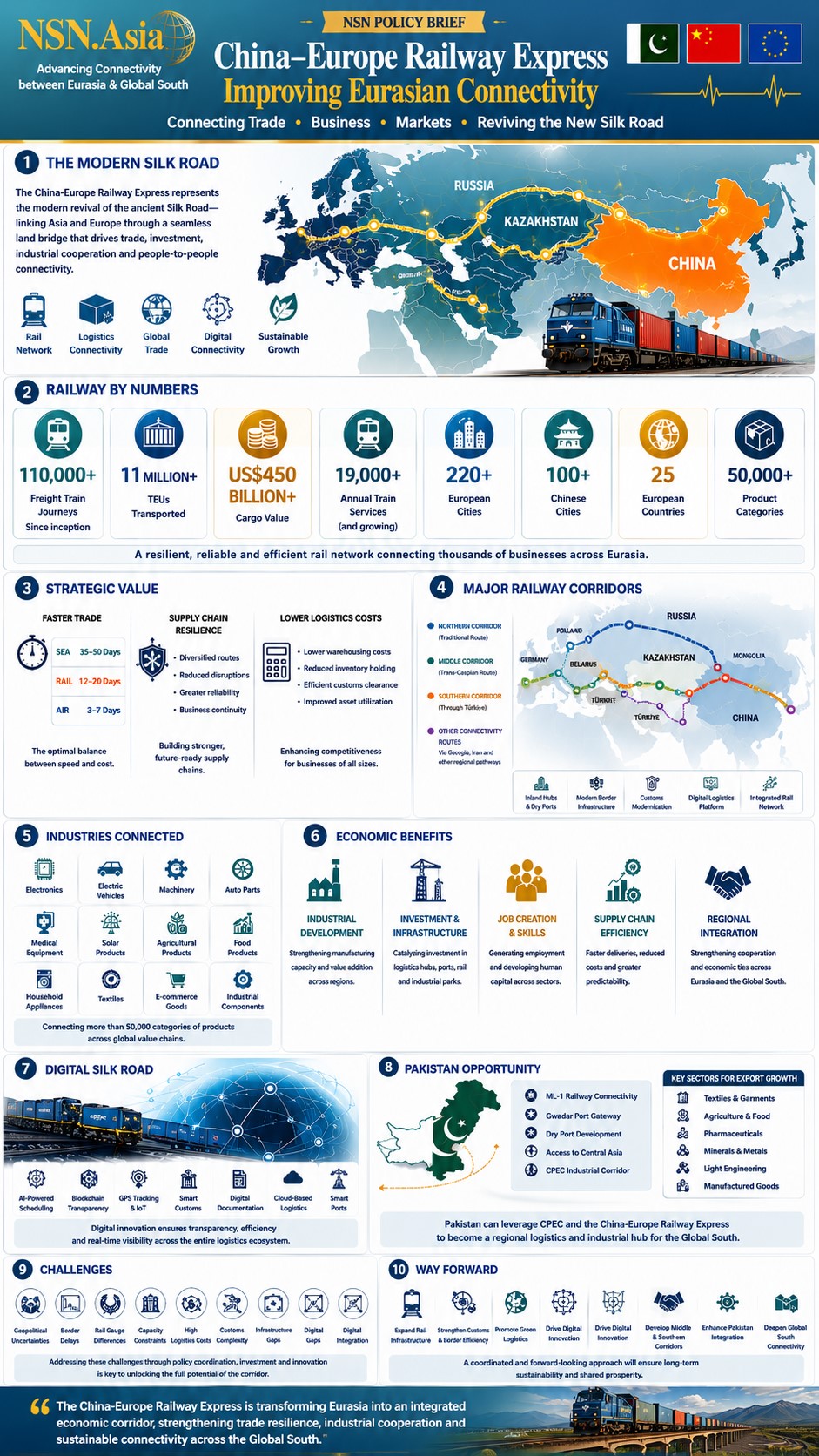
Today, the network serves:
- More than 220 cities in Europe
- Over 100 Chinese cities
- Around 25 European countries
- Transit through Central Asia and neighboring regions
- Thousands of logistics enterprises
The railway has expanded from a handful of pilot services into a sophisticated network operating daily trains in both directions.
Its rapid development reflects growing confidence among manufacturers, exporters, importers, and logistics companies.
Record Cargo Volumes
The China-Europe Railway Express has experienced remarkable growth over the past decade.
Recent operational statistics indicate:
- More than 110,000 cumulative freight train journeys since operations began.
- Over 11 million TEUs (Twenty-foot Equivalent Units) transported.
- Cargo valued at well above US$450 billion.
- Annual train departures now exceed 19,000 services, with continued year-on-year growth.
- Rail services connect over 50,000 categories of products, ranging from industrial machinery to cross-border e-commerce goods.
The network has maintained steady expansion despite global disruptions such as the COVID-19 pandemic, shipping bottlenecks, and geopolitical tensions, demonstrating the resilience of rail freight as a strategic transport option.
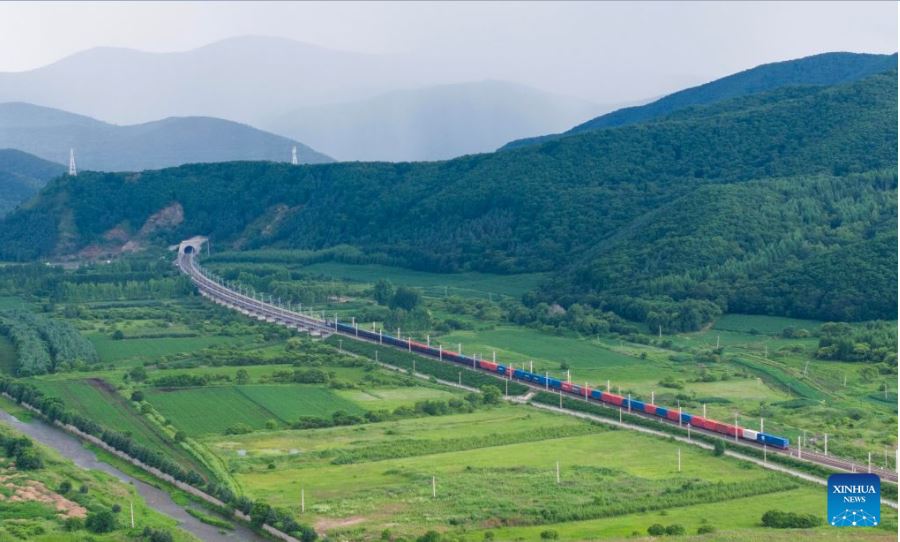
Connecting Eurasian Markets
The railway has fundamentally changed how businesses trade across Eurasia.
Previously, companies relied primarily on:
- Ocean shipping
- Air freight
- Limited overland trucking
Each option presented challenges.
Sea transport is economical but slow.
Air freight is fast but expensive.
Rail now offers a balanced alternative.
Average delivery times:
| Mode | Transit Time |
|---|---|
| Sea | 35–50 days |
| Rail | 12–20 days |
| Air | 3–7 days |
This middle-ground solution has attracted manufacturers seeking reliable delivery while controlling logistics costs.
Strengthening Regional Connectivity
The China-Europe Railway Express crosses numerous countries, including:
- China
- Kazakhstan
- Mongolia
- Russia
- Belarus
- Poland
- Germany
- Hungary
- Serbia
- Türkiye
- Uzbekistan
- Azerbaijan (via multimodal routes)
- Georgia
These corridors have encouraged investment in:
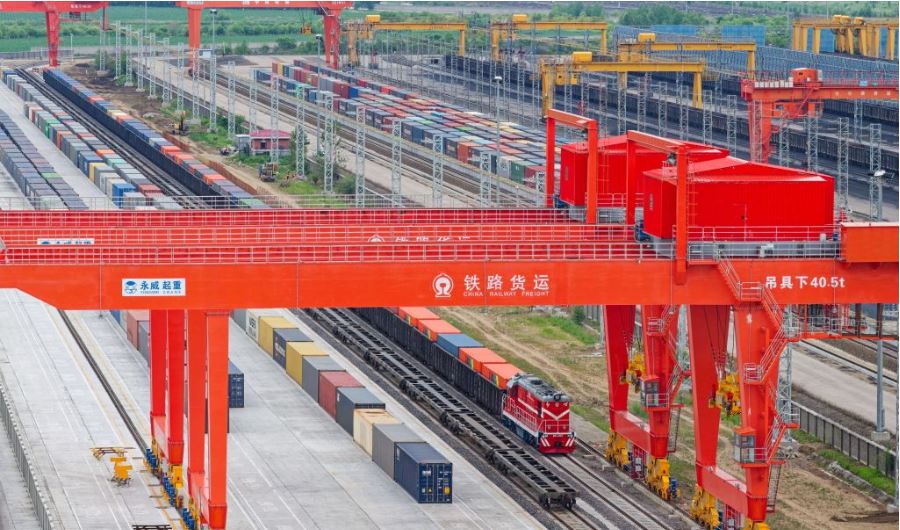
- Inland logistics hubs
- Dry ports
- Container terminals
- Border infrastructure
- Customs modernization
- Digital logistics platforms
Cities once considered remote inland locations have become major logistics centers.
Examples include:
- Xi’an
- Chongqing
- Chengdu
- Zhengzhou
- Wuhan
- Duisburg
- Lodz
- Budapest
Boosting International Trade
The railway supports trade by enabling:
- Faster inventory turnover
- Lower warehousing costs
- Improved supply chain predictability
- Better market access for SMEs
- Just-in-time manufacturing
For exporters, reduced delivery times improve competitiveness.
For importers, predictable schedules reduce inventory risks.
This has encouraged greater cross-border commercial activity across Eurasia.
Driving Cross-Border E-Commerce
One of the fastest-growing users of the China-Europe Railway Express is the e-commerce industry.
Major online retailers increasingly depend on rail to transport:
- Consumer electronics
- Fashion
- Home appliances
- Sports equipment
- Furniture
- Toys
Rail offers:
- Faster delivery than sea
- Lower costs than air freight
- Reduced carbon emissions
As cross-border online shopping expands, rail logistics continues to gain market share.
Supporting Green Logistics
Compared with air transport, rail freight significantly reduces carbon emissions.
According to logistics industry estimates:
- Rail emits roughly 80–90% less CO₂ than air freight for equivalent cargo volumes.
- Energy-efficient rail systems contribute to national decarbonization goals.
- Electrified railway corridors support cleaner transport compared with diesel-dependent alternatives.
As governments pursue net-zero commitments, the China-Europe Railway Express aligns with global efforts to promote sustainable logistics.
Economic Benefits Across Eurasia
The railway generates wide-ranging economic benefits.
These include:
Job Creation
Expansion of logistics parks creates employment in:
- Warehousing
- Customs
- Freight forwarding
- Manufacturing
- Container handling
Industrial Development
Manufacturers increasingly locate production facilities near rail hubs.
Industrial clusters have developed around:
- Xi’an
- Chengdu
- Chongqing
- Zhengzhou
Similar developments are emerging in Central Asia and Eastern Europe.
SME Opportunities
Small and medium-sized enterprises now enjoy greater access to overseas markets without relying solely on maritime transport.
This supports export diversification.
Investment Attraction
Improved transport infrastructure encourages foreign direct investment.
Logistics reliability remains a key factor influencing investment decisions.
Importance for Central Asia
Central Asia has become a major beneficiary.
Kazakhstan, in particular, has transformed into one of Eurasia’s most important logistics gateways.
Major dry ports, including Khorgos, have become central transfer points between China’s standard-gauge railway and the broader Eurasian rail network.
Countries such as Uzbekistan and Kyrgyzstan are also improving transport links to integrate more closely into regional supply chains.
Opportunities for Pakistan
Although Pakistan is not yet directly connected to the China-Europe Railway Express network, significant opportunities exist through the China-Pakistan Economic Corridor (CPEC).
Future possibilities include:
- Integration of Gwadar Port with Eurasian logistics.
- Rail modernization under ML-1.
- Dry ports linked to Central Asia.
- Transit trade with Western China.
- Export corridors for textiles, agriculture, pharmaceuticals, and minerals.
Enhanced regional railway connectivity could eventually position Pakistan as a complementary gateway connecting maritime and overland trade routes.
Digital Transformation
Modern railway operations increasingly depend upon digital technologies.
These include:
- Electronic customs clearance
- AI-powered scheduling
- GPS cargo tracking
- Digital freight documentation
- Blockchain-enabled supply chain verification
- Smart logistics platforms
Digitalization reduces border delays while improving cargo visibility.
Challenges Ahead
Despite remarkable success, challenges remain.
These include:
Geopolitical uncertainty
International political tensions continue affecting certain transit routes.
Infrastructure bottlenecks
Border crossings occasionally experience congestion due to differing railway gauges and customs procedures.
Operational costs
Rail remains more expensive than sea freight for certain cargo categories.
Capacity constraints
Growing demand requires continued investment in:
- Rolling stock
- Container terminals
- Digital systems
- Customs modernization
Route diversification
Expansion of:
- Middle Corridor
- Caspian routes
- Southern corridors
will strengthen resilience.
Future Outlook
The future of the China-Europe Railway Express appears promising.
Emerging trends include:
- Greater integration with Central Asian railways.
- Increased multimodal transport combining rail, ports, and highways.
- Expansion of digital Silk Road technologies.
- Growth of green logistics initiatives.
- Increased use for electric vehicle exports.
- Better customs coordination.
- Wider participation by developing economies.
As Eurasian economies continue integrating, rail freight is expected to play an even greater role.
The Strategic Importance of the New Silk Road
The China-Europe Railway Express is not merely a transport service.
It represents:
- Economic integration
- Regional cooperation
- Supply chain resilience
- Infrastructure connectivity
- Shared development
The railway supports broader objectives including:
- Trade facilitation
- Industrial cooperation
- Investment promotion
- Regional development
- Sustainable transport
Its success illustrates how infrastructure can become a catalyst for economic transformation.
Way Forward
To maximize the benefits of the China-Europe Railway Express, governments and stakeholders should focus on:
- Expand Rail Infrastructure: Invest in additional tracks, intermodal terminals, and dry ports to increase capacity and reduce congestion.
- Enhance Customs Cooperation: Accelerate harmonization of customs procedures through digital platforms and mutual recognition agreements.
- Strengthen Multimodal Connectivity: Integrate rail with seaports, highways, inland waterways, and air cargo hubs to create seamless logistics networks.
- Promote Green Transport: Increase electrification, adopt renewable energy for logistics hubs, and incentivize low-carbon freight solutions.
- Support SMEs: Provide affordable logistics services, digital trade platforms, and export financing so that small and medium-sized enterprises can fully benefit from Eurasian rail connectivity.
- Diversify Routes: Expand the Middle Corridor and Southern Corridor to enhance resilience against geopolitical or operational disruptions.
- Integrate Emerging Economies: Countries such as Pakistan, through CPEC, can position themselves as complementary gateways by modernizing rail infrastructure and linking ports with inland logistics networks.
- Leverage Digital Innovation: Deploy artificial intelligence, blockchain, and smart customs systems to improve cargo tracking, security, and efficiency.
Conclusion
The China-Europe Railway Express has evolved from a visionary infrastructure project into one of the world’s most important transcontinental logistics networks. By significantly reducing transit times, connecting hundreds of cities across Asia and Europe, and carrying goods worth hundreds of billions of dollars, it has become a cornerstone of modern Eurasian trade.
Beyond freight transport, the railway symbolizes the revival of the New Silk Road—promoting connectivity, investment, industrial cooperation, and people-to-people exchanges across a vast region. As businesses seek resilient supply chains and governments prioritize sustainable infrastructure, the China-Europe Railway Express is well positioned to play an even greater role in shaping the future of global commerce.
For countries across the Global South, including Pakistan, the expanding Eurasian rail network presents new opportunities to integrate into regional value chains, diversify exports, and attract investment. Through strategic infrastructure development, digital innovation, and enhanced regional cooperation, the China-Europe Railway Express can continue to strengthen economic connectivity and foster shared prosperity across Eurasia for decades to come.
About the Author