



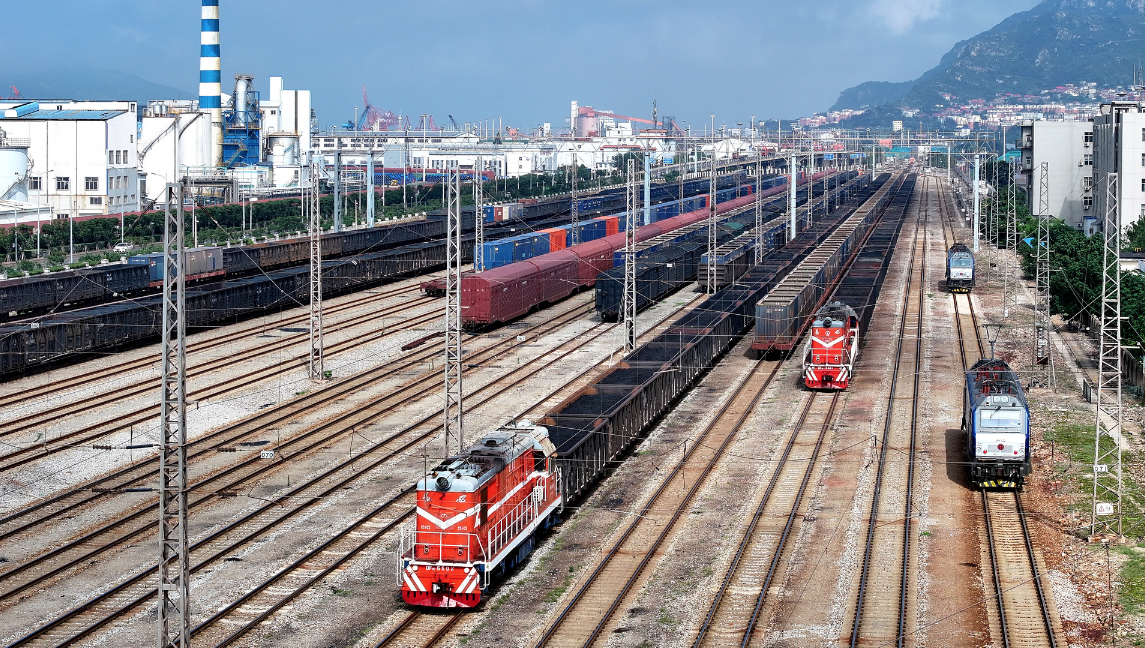
Earlier this month, with the sound of a long whistle, a China-Europe freight train slowly departed from Wujiashan Station in Wuhan, the capital of central China’s Hubei Province. Fully loaded with 55 containers of textiles, medical supplies, electronic products and other goods, the train set off on its westward journey to Duisburg, Germany, thousands of miles away.
This trip marks a significant milestone. As of July 10, this year’s ˇtrips had surpassed 10,000, breaking the mark 19 days earlier than last year.
According to China State Railway Group Co., Ltd (China Railway), the freight train service network currently reaches 224 cities in 25 European countries and connects over 100 cities in 11 Asian countries, covering almost the entire Eurasian continent. Moreover, the trains have transported more than 1.08 million twenty-foot equivalent unit (TEU) containers of goods this year, up 11 percent yearly.
These achievements testify to the trips’ increasing efficiency and volume, profoundly impacting international trade and logistics.

Launched in 2011, the China-Europe freight rail transformed land transportation between China and Europe. The inaugural journey covered 11,000 kilometers from Chongqing, China, to Duisburg, Germany, in just 16 days. This success prompted the expansion of routes, connecting Chinese cities like Chengdu, Wuhan, Zhengzhou and Yiwu to European destinations such as Warsaw, Madrid, London and Moscow.
The Belt and Road Initiative (BRI), introduced in 2013, bolstered the China-Europe freight train service. The initiative seeks to enhance trade and connectivity between China and countries along the ancient Silk Road, including Europe. Consequently, the China-Europe freight train service has become a critical part of the BRI, facilitating trade and fostering economic ties between the two regions.
Previously, coastal cities dominated trade due to their proximity to seaports. However, with the advent of the China-Europe freight train service, inland cities have emerged as essential logistics centers and trade gateways. This connectivity has opened up new business opportunities in these cities, attracting foreign investment, promoting international trade and driving economic development.
Xi’an, the capital city of Shaanxi Province in northwest China, has become a key hub for BRI and the China-Europe freight train service. As the starting point of the ancient Silk Road, Xi’an has become a vital node linking Asia and Europe.
Despite its location in China’s heartland, Xi’an has become a critical assembly center. In just 10 years since the Xi’an route was launched in 2013, the number of trains the city operated has grown significantly, from 46 in the inaugural year to over 5,300 in 2023.
Today, the Xi’an International Port Station operates 18 regular international routes, including destinations in Almaty in Kazakhstan, Tashkent in Uzbekistan and Hamburg in Germany. It crosses the Caspian Sea before heading west. These routes cover the entire Eurasian continent, connecting Xi’an to major international trade hubs.
According to China Railway, the Xi’an route operated 2,372 trains from January to June this year, marking a growth of 13.1 percent year-on-year. The number of containers transported reached 250,000 TEUs, a 10.4 percent increase.
This sustained growth exemplifies the economic vitality unleashed by the Eurasian “golden corridor,” elevating inland cities like Xi’an to the forefront of China’s opening-up.
Customs data indicates that in 2023, Shaanxi, Zhejiang and Jiangsu were the top three provinces with exports utilizing Xi’an China-Europe freight trains, while Shaanxi, Liaoning and Fujian dominated imports.
“In previous years, coastal provinces in the eastern region typically held the top rankings, while Shaanxi ranked around seventh or eighth,” said Cui Ying, director of the statistics and analysis department of Xi’an Customs. However, in recent years, the China-Europe freight train (Xi’an) has become increasingly integrated with local industries and enterprises in Shaanxi, resulting in significant economic benefits for the region. Many local companies in Xi’an have achieved impressive export results through the China-Europe freight train, Cui said.
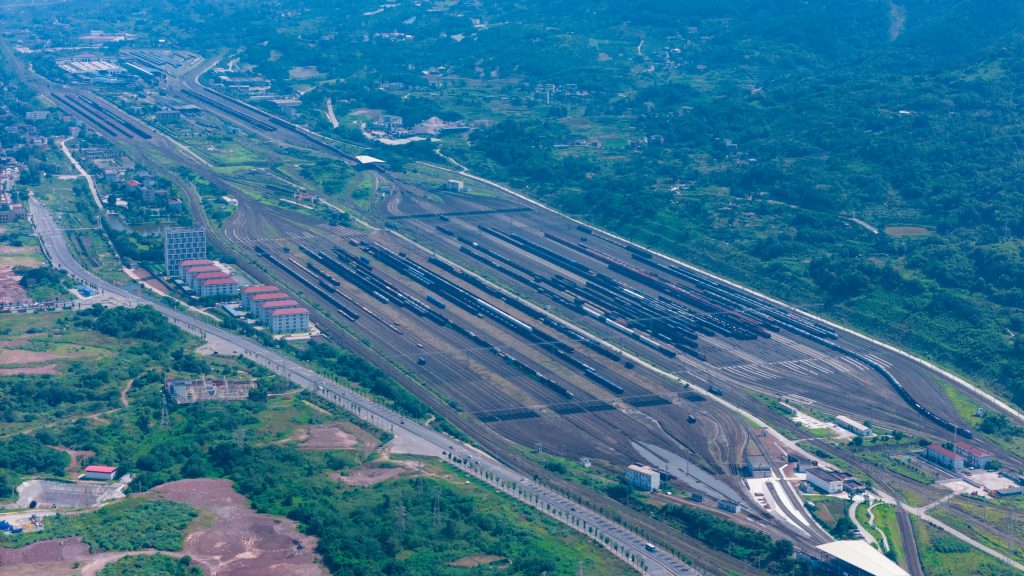
In recent years, there has been a significant increase in the connectivity of China-Europe freight trains.
In response to the increasing demand for rail transport between China and Europe, the China-Europe freight train service has undergone substantial network expansion and service upgrades.
In February, Chongqing initiated its inaugural China-Europe freight train service to Istanbul, Türkiye. Industry experts have seen this development as a significant enhancement to the corridor linking western China with Europe. Despite ongoing regional conflicts, the Istanbul train service has played a pivotal role in strengthening the China-Europe freight train network’s risk resilience and development potential.
“The train services provide a guarantee for the timely arrival of our goods and effectively reduce our operational risks,” said Zhang Rong, deputy general manager of Yuxinou (Chongqing) Logistics Co., Ltd., the operator of the China-Europe freight train service in Chongqing.
In addition to expanding its network, the China-Europe freight train service has witnessed remarkable improvements in transport capacity, efficiency and service quality. These enhancements have contributed to the service’s overall success and competitiveness.
“To ensure the smooth operation of the trains, we have maintained timely communication with export enterprises and enhanced ‘automatic clearance.’ We efficiently connect declaration, document review and inspection, continuously monitoring the progress of customs clearance and railway manifests,” said Chen Yuanjun, deputy director of Yuzhou Customs in Chongqing, adding that close contact is maintained with customs authorities of destination countries to ensure smooth transit and loading.
The enhanced connectivity provided by the China-Europe freight trains has diversified the products being transported. Initially, the trains mainly carried products like laptops and printers. However, the range of commodities has expanded to over 50,000 types, including clothing, automobiles, daily necessities, food, timber, furniture, chemicals and machinery.
These trains are pivotal in facilitating the global transport of “Made in China” products. Since 2023, there has been an increasing demand for Chinese-made “tech-intensive green trio” products, namely lithium-ion batteries, photovoltaic products and new energy vehicles (NEVs), which are now being transported through the China-Europe freight trains.
Horgos, a border city located in northwest China’s Xinjiang Uygur Autonomous Region, has also developed closer ties with the world with the launch of the China-Europe freight trains.
Yang Jiayi has worked in international freight forwarding in Horgos for nine years, specializing in exporting NEVs. This year, his company has witnessed a significant growth in NEV exports compared to the previous year. So far, his company has provided freight forwarding services for over 9,000 NEVs, which are transported to Central Asian and European countries.
As the benefits of the China-Europe freight train continue to emerge, Central Asian countries are actively seeking to join in.
The freight terminal, China-Kazakhstan (Xi’an) Trade Logistics, was jointly launched by KTZ Express, a subsidiary of Kazakhstan’s national railway company Kazakhstan Temir Zholy (KTZ), and Xi’an Free Trade Port Construction and Operation, earlier this year, facilitating an efficient “hub-to-hub” logistics corridor.
“The aim of the terminal in Xi’an is for it to be a transfer hub and warehouse so that goods can be transferred between China, Kazakhstan, Central Asia and even Europe and other places more efficiently,” said Sadvakkas Seitzhanov, general manager of the Chinese branch of KTZ Express, noting that with the terminal, the transit time from Xi’an to Tashkent in Uzbekistan has been reduced from 13 to nine days.
“We adjust the shipment schedule based on real-time market demand, share information about the train service and provide one-stop service to our clients. The booming bilateral trade in recent years has given us the confidence to expand business in China,” he added.

The China-Europe freight train service has transformed cross-border logistics, facilitating economic and trade exchanges and bringing prosperity along the routes.
“As a local, I have witnessed the rapid development of the China-Europe freight trains in Horgos firsthand,” Yang said. “Over the years, I have seen the station’s establishment and expansion. The local government has also continued to revise its investment policies, attracting talent from diverse locations and boosting local employment.” Yang said that the freight train service has helped him advance his career.
Adilya Saidullaev, a businesswoman from Kazakhstan, has experienced significant growth in her business since venturing into Horgos in 2016. This success has allowed her to establish multiple duty-free shops at the China-Kazakhstan Horgos International Border Cooperation Center, the first cross-border cooperation zone between China and another country.
“Our products are seamlessly transported through the China-Europe freight trains, a more cost-effective service than air and road transportation. This has significantly bolstered our business operations at the cooperation center,” Saidullaev said.
She added the cooperation center allows Chinese visitors to purchase products here without traveling to Kazakhstan.
In Germany’s Ruhr area, Duisburg is a vital hub for China-Europe freight trains. Formerly reliant on coal and steel, the city has become a prominent trade gateway between Europe and Asia. The railway route has revitalized Chinese-German exchanges and cooperation, making Duisburg a prominent European trading hub.
“The rail connection between China and Duisburg continues to be a highly interesting alternative to sea and air freight for companies. It will continue to develop positively if the global political framework allows it,” Soeren Link, mayor of Duisburg, told Xinhua.
“This logistics project has had a positive impact on the exchange of goods between Germany and China because the use of this train connection has ecological and economic advantages for Chinese and German companies,” Markus Teuber, China affairs commissioner of the City of Duisburg, told Xinhua, noting that due to this train connection, many Chinese companies have also settled in Duisburg, which has created new jobs.
“The train connection has definitely led to a win-win situation for both countries,” Teuber added.
Source(s): Xinhua News Agency
About the Author