

Silk Road News, covers revival of Silk Road , with focus on Connectivity, Cooperatoion projects between Eurasia, Global South and beyond.
What Was the Silk Road?
A vast network of overland and maritime trade routes connecting China, Central Asia, South Asia, the Middle East, Africa, and Europe
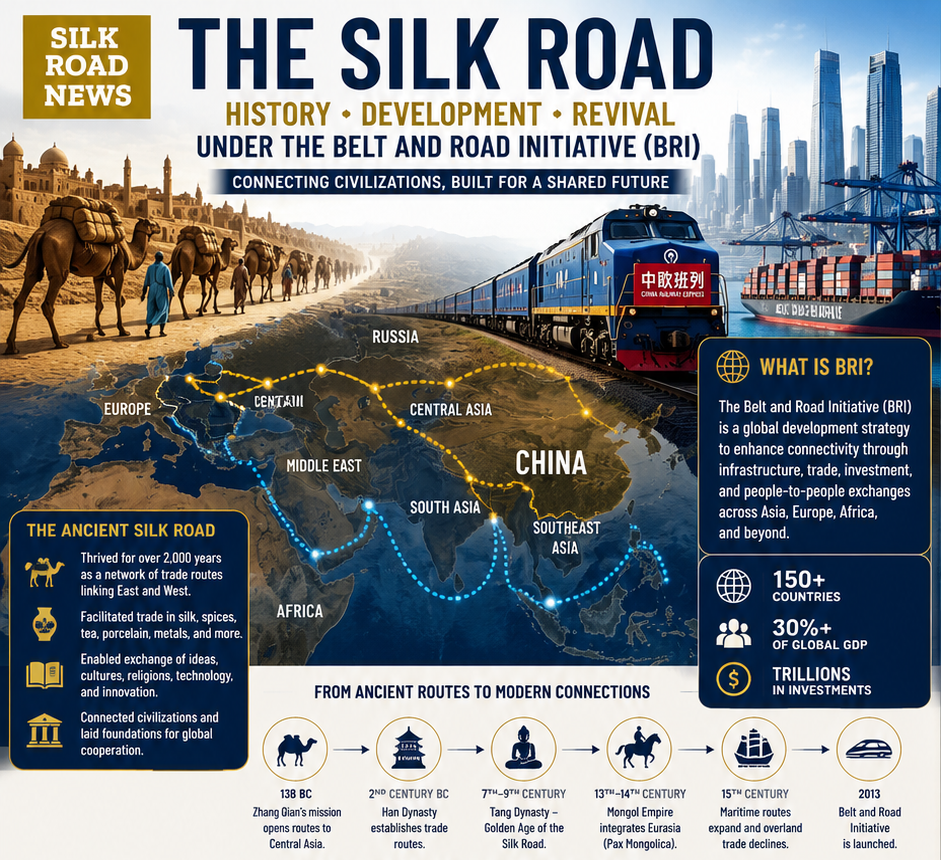
The Silk Road was not a single road but a vast network of overland and maritime trade routes connecting China, Central Asia, South Asia, the Middle East, Africa, and Europe for more than two millennia. Stretching nearly 12,000 kilometers, it served as the world’s first major globalization network, enabling the exchange of goods, technologies, ideas, religions, and cultures.
The term “Silk Road” (German: Seidenstraße) was coined by German geographer Ferdinand von Richthofen in 1877 because Chinese silk was among the most valuable commodities traded across Eurasia.
How Did the Silk Road Begin?
The Silk Road originated during China’s Han Dynasty (206 BC–220 AD) after imperial envoy Zhang Qian traveled to Central Asia in 138 BC. His mission established diplomatic relations with western kingdoms and opened new commercial opportunities.
Soon, camel caravans began transporting goods across deserts, mountains, and grasslands, linking East and West.
More Than Trade
The Silk Road transformed civilizations by facilitating:
- Exchange of scientific knowledge
- Spread of Buddhism, Islam, Christianity, and other beliefs
- Transfer of technologies such as papermaking, printing, gunpowder, and the compass
- Development of medicine, astronomy, mathematics, and architecture
- Cultural interactions through art, music, language, and diplomacy
Historians often describe it as the first great bridge between civilizations.
What Goods Were Traded?
From China
- Silk
- Tea
- Porcelain
- Paper
- Gunpowder
- Lacquerware
From Central Asia, the Middle East, and Europe
- Horses
- Gold and silver
- Glassware
- Wool and textiles
- Precious stones
- Spices
- Wine
Silk remained the most prized export, giving the network its modern name.
Why Did the Silk Road Decline?
Beginning in the 15th century, several developments weakened the traditional routes:
- Expansion of European maritime exploration
- Faster and cheaper sea transport
- Political instability across Central Asia
- Fragmentation of major empires
- Changing global trade patterns
By the 16th century, maritime trade had largely overtaken the ancient caravan routes.
The 21st Century Revival: Belt and Road Initiative (BRI)
In 2013, Chinese President Xi Jinping proposed reviving the spirit of the Silk Road through the Belt and Road Initiative (BRI).
The initiative consists of two major components:
1. Silk Road Economic Belt
A network of land-based transport corridors connecting China with Central Asia, West Asia, Russia, and Europe.
2. 21st Century Maritime Silk Road
A modern maritime trade network linking Chinese ports with Southeast Asia, South Asia, Africa, the Middle East, and Europe.
Together, they aim to strengthen global connectivity through infrastructure and economic cooperation.
What Is BRI Building?
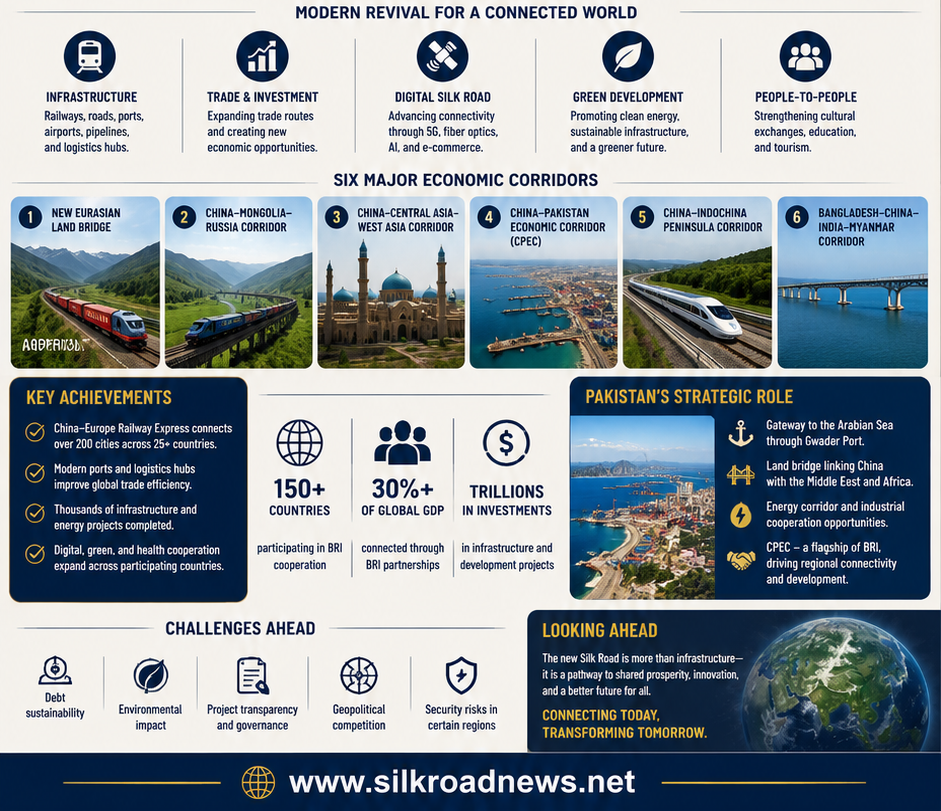
Under BRI, participating countries are developing:
- High-speed railways
- Freight rail corridors
- Expressways
- Deep-sea ports
- Airports
- Energy pipelines
- Power plants
- Industrial parks
- Logistics hubs
- Fiber-optic cables
- Digital infrastructure
The initiative seeks to reduce transport times, lower logistics costs, and improve regional trade connectivity.
Six Major Economic Corridors
The Belt and Road Initiative includes six principal land corridors:
- New Eurasian Land Bridge
- China–Mongolia–Russia Economic Corridor
- China–Central Asia–West Asia Corridor
- China–Pakistan Economic Corridor (CPEC)
- China–Indochina Peninsula Corridor
- Bangladesh–China–India–Myanmar Corridor (currently limited in progress)
These corridors connect manufacturing centers with major consumer markets across Eurasia.
The Digital Silk Road
The BRI has expanded beyond physical infrastructure to include the Digital Silk Road, focusing on:
- Artificial Intelligence (AI)
- 5G telecommunications
- E-commerce
- Cloud computing
- Smart cities
- Data centers
- Satellite navigation
- Cross-border digital services
This digital dimension reflects the growing importance of technology in global development.
Pakistan’s Strategic Position
Pakistan occupies a pivotal position at the crossroads of South Asia, Central Asia, and West Asia.
Through the China–Pakistan Economic Corridor (CPEC), Pakistan serves as:
- China’s gateway to the Arabian Sea via Gwadar Port
- A regional logistics and transit hub
- A potential energy corridor
- A center for industrial cooperation through Special Economic Zones
- A bridge linking western China with global markets
CPEC is widely regarded as one of the flagship projects of the Belt and Road Initiative.
Why the Silk Road Matters Today
The revival of Silk Road connectivity is driven by several strategic objectives:
- Diversifying global supply chains
- Enhancing regional connectivity
- Expanding international trade
- Supporting infrastructure-led development
- Promoting people-to-people exchanges
- Strengthening economic integration across Eurasia
For many developing countries, improved infrastructure can reduce trade costs and increase access to regional and global markets.
Challenges
Despite its scale, the Belt and Road Initiative also faces challenges, including:
- Debt sustainability concerns
- Project financing
- Environmental impacts
- Geopolitical competition
- Security risks in some regions
- Governance and transparency issues
Supporters argue that the initiative addresses major infrastructure gaps, while critics emphasize the importance of financial sustainability, environmental safeguards, and local economic benefits.
Looking Ahead
As global trade evolves, the modern Silk Road is increasingly viewed as a network of railways, ports, digital infrastructure, and economic partnerships rather than a single route. Its future success will depend on balancing infrastructure investment with transparency, sustainability, and broad-based economic cooperation.
Key Takeaways
- Ancient Legacy: The Silk Road connected civilizations for over 2,000 years through trade and cultural exchange.
- Modern Revival: China launched the Belt and Road Initiative in 2013 to modernize Eurasian connectivity.
- Beyond Infrastructure: BRI now includes digital, green, health, and innovation cooperation alongside transport networks.
- Pakistan’s Role: Through CPEC and Gwadar Port, Pakistan occupies a strategic position in connecting China with the Arabian Sea and broader regional markets.
- Global Impact: The initiative has the potential to reshape trade, logistics, and economic integration across Eurasia, while continuing to face debates over governance, financing, and sustainability.